Blink Outdoor 4 vs Ring vs Wired Cameras: Which One Actually Wins
Wired is assumed to be serious and wireless a toy. That framing is mostly outdated, though wired still wins in a few specific situations.
ReviewHubNow Editorial Team
ReviewHubNow Editorial Team
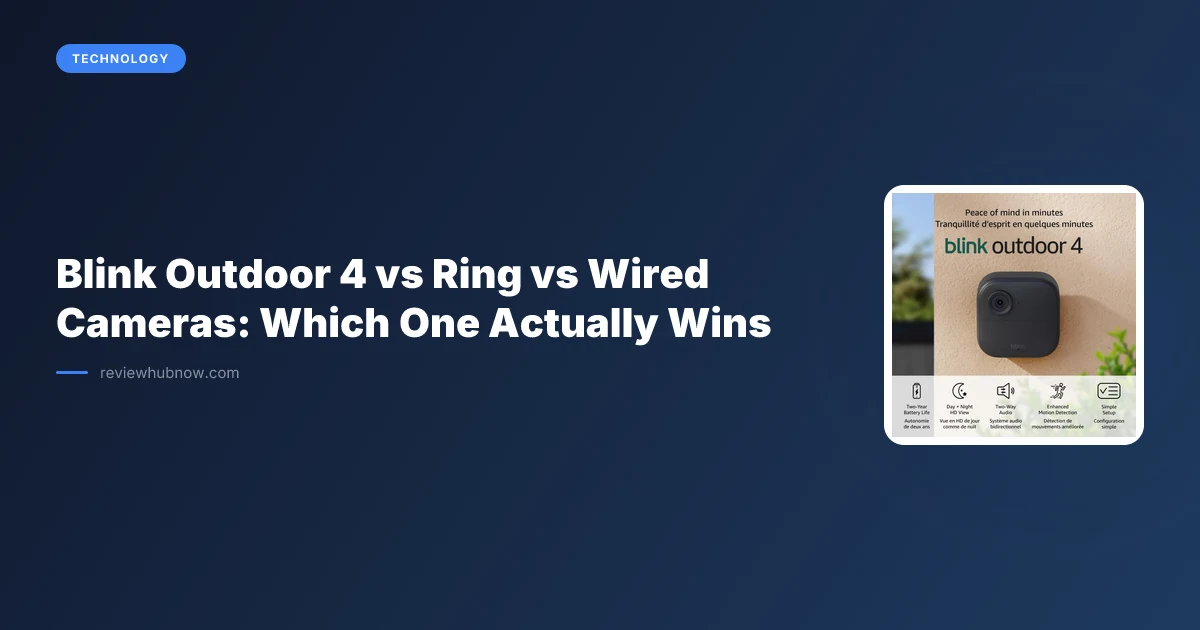
Ask most people to picture a good security camera and they describe something hardwired, tucked into the eaves and feeding a hub indoors. The assumption underneath is that wired means serious and wireless means a gadget, with battery cameras filed alongside smart plugs rather than actual protection.
That framing is largely out of date. Wired still wins in specific circumstances worth naming, and the general belief that wireless equals compromise does not survive contact with what these devices now do.
Do wireless cameras miss footage that wired cameras catch?
Rarely, though the concern is technically valid. A hardwired camera on constant power can record continuously, while a battery camera sleeps until motion wakes it, which leaves a theoretical gap.
In practice that gap is measured in fractions of a second. Modern detection triggers quickly enough that recording begins within a stride or two of someone entering frame, which nobody on foot outruns. For a residential driveway or porch, motion-triggered recording captures what you need.
Continuous recording genuinely matters on commercial property, or anywhere frame-by-frame documentation is needed for insurance or legal purposes. Our Blink and Ring comparison covers the detection differences, which are close enough that placement matters more than the specification sheet.
Do you need Ring for a system that works?
No, and the assumption that you do comes from Ring arriving early and reaching every big-box shelf rather than from any technical advantage. What that reputation obscures is the subscription structure.
Ring's cloud plans charge monthly per camera, and without payment you lose video history and keep little beyond live view. Across a four-camera property that becomes a substantial annual cost to retain footage recorded on hardware you already bought.
Blink inverts the arrangement. A Sync Module lets you store clips on a local USB drive with no subscription at all, and the Outdoor 4 runs on replaceable AA lithium cells with genuinely long service intervals, though cold winters shorten that meaningfully. Our roundup of no-subscription cameras covers the wider field, where Blink stands out for not feeling like a sacrifice to get there.
Are hardwired systems more reliable?
Less decisively than they used to be. Older wireless cameras genuinely struggled with range and dropped connections beyond a modest distance from the router, and that reputation outlived the problem.
Current wireless cameras handle distance better because most support mesh extenders or dedicated sync modules, which establish a stronger local link than relying on raw router signal across a house. A detached garage or a far corner that would once have been unworkable is now generally fine with a sync module in between.
Wired retains two real advantages: continued operation during power outages when the system runs on battery backup at the panel, and no dependence on internet connectivity for local recording. Frequent extended outages or unreliable internet make wired the correct choice. Otherwise the reliability gap has narrowed enough that it should not decide the purchase. Our installation guide covers where wireless still creates difficulties.
Do more cameras mean better protection?
No, and this assumption costs buyers the most money. The instinct is to buy the largest bundle with the most cameras and features, on the theory that protection scales with spending.
What actually deters opportunistic break-ins is unglamorous: visible cameras at entry points, motion-activated lighting, and a doorbell camera that announces itself audibly when someone approaches. Two cameras covering the front door and driveway deter more than eight cameras where half point at ground nobody crosses on foot.
Covering the right three or four approaches beats blanket coverage, and it costs considerably less.
Which should you buy?
For strong coverage without a recurring bill, the Blink Outdoor 4 with a sync module is the sensible default: long battery service intervals, no subscription requirement, and detection quick enough to match anything in its class.
Anyone already committed to the Ring and Alexa ecosystem who accepts the monthly cost has a capable system, though not a better one for the money.
Unreliable internet or a genuine need for continuous recording still points to wired, not because wireless failed but because those requirements are specific and most households do not have them.
The camera that protects a home best is not the one with the longest feature list. It is the one actually recording, storing footage somewhere you can retrieve it, and pointed at the door someone will walk through.
Editor's Pick
Affiliate link. We may earn a commission if you buy through it, at no extra cost to you.

More from Our Editors
Hook-On High Chair vs High Chair for Small Apartment
By ReviewHubNow Editorial Team
Robot Vacuum Mop or Wet Dry Vacuum for Hard Floors?
By ReviewHubNow Editorial Team
Does Noise Cancelling Work for Office Chatter?
By ReviewHubNow Editorial Team