Blink Outdoor 4 vs Ring: Which Outdoor Camera Should You Buy?
The camera is rarely the deciding factor. Subscription cost over three years, battery chemistry in winter, and footage privacy matter far more.
ReviewHubNow Editorial Team
ReviewHubNow Editorial Team
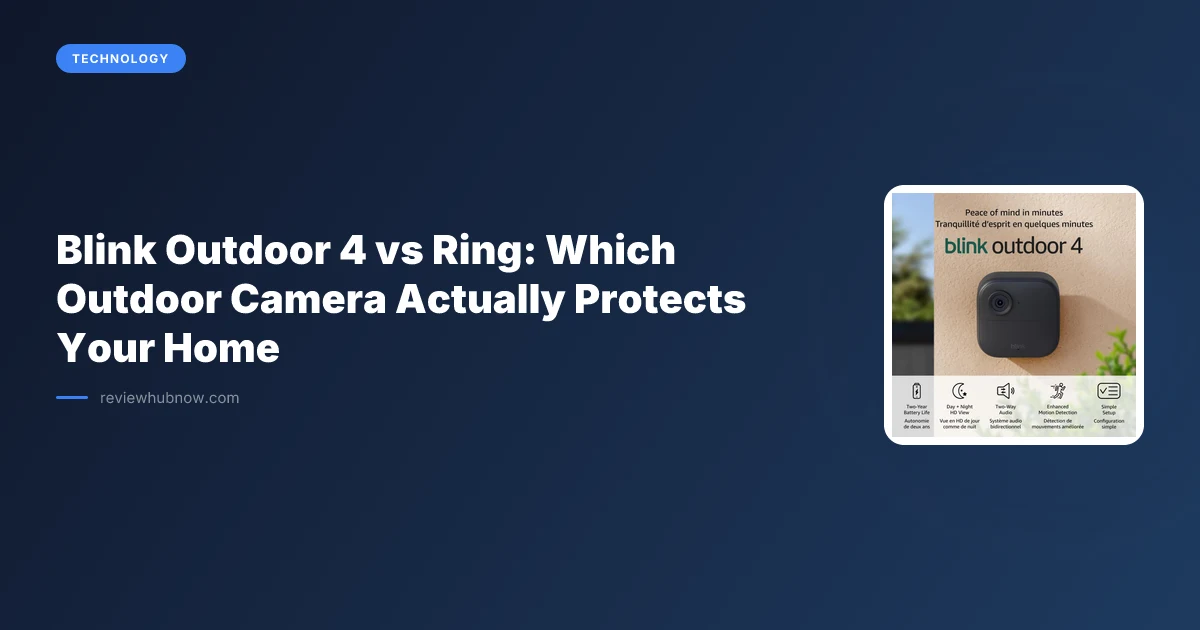
Comparing outdoor cameras on video specifications misses what actually determines whether you are happy with the system a year later. Three factors decide that: what the subscription costs across the life of the system, how much maintenance the batteries demand, and what happens to your footage once it leaves your property.
Blink and Ring are both owned by Amazon and sit at different points on all three. Here is how the comparison breaks down.
Which is cheaper over three years, Blink or Ring?
Blink, and usually by a wide margin, because the gap lives in the subscription rather than the hardware. Blink cameras are typically less expensive to buy, and Blink's plans are priced well below Ring's equivalents, with annual billing cheaper still. Ring's per-camera plan costs more, though its whole-property tier becomes competitive once you are running many cameras.
The arithmetic that matters is hardware plus three years of subscription for the number of cameras you actually intend to install. A single camera and a six-camera property produce very different answers, and Ring's unlimited tier is precisely designed for the second case. Work it out for your own setup before comparing sticker prices, because the subscription typically outgrows the hardware cost.
Blink also has the advantage in battery format. It runs on replaceable AA lithium cells rated for a long service life, so maintenance means swapping batteries occasionally. Ring's rechargeable packs need bringing indoors to charge every few months, which is a recurring task rather than a rare one.
Which has better video quality?
Ring, at its higher tiers. The Spotlight Cam range and above deliver sharper footage, better colour rendering at night and a wider field of view than Blink's fixed lens. Anyone who wants to zoom in and study detail rather than simply confirm someone was present will notice the difference.
Blink's 1080p is adequate for the job most people actually need: identifying a person at the door or a vehicle in the driveway. Motion detection is competent rather than exceptional, and false triggers from branches and passing traffic occur, as they do across this price class.
The base Ring models are the weakest value in this comparison, since they cost more than Blink without the sensor advantage of the premium tiers. Buying Ring for image quality means buying the higher-tier cameras specifically.
How do these cameras handle cold weather?
Both lose runtime in the cold, and they lose it differently. Lithium AA cells, which Blink uses, tolerate low temperatures comparatively well, so the decline is noticeable without being severe. Rechargeable lithium-ion packs, which Ring uses, drop off more sharply, and a pack rated for months can need recharging in weeks through a genuine Canadian winter.
This is chemistry rather than a manufacturing defect, and it makes mounting height a practical concern in a cold climate. A camera that needs recharging every six weeks and sits high on a soffit is a camera that will eventually be left flat. Our installation guide covers placement and the battery planning that goes with it.
What about privacy and police access to footage?
This deserves stating plainly, because most comparisons omit it. Ring built partnerships that gave law enforcement agencies a channel to request footage from users, an arrangement that drew sustained criticism and that Amazon has since scaled back. Ring has also faced regulatory action in the United States over employee access to customer video.
Blink is an Amazon subsidiary and sits under the same corporate policies, so it is not a privacy-first alternative in any strong sense. It has not built the same police-request infrastructure Ring did, which is a meaningful difference in practice rather than a difference in principle.
Anyone for whom this weighs heavily should look at cameras with local storage and no mandatory cloud account, which is a different market segment with its own trade-offs, covered in our guide to cameras without monthly subscriptions.
So which should you buy?
Choose Blink Outdoor 4 for dependable perimeter coverage with minimal upkeep and the lower running cost, particularly across several cameras and cold winters. It handles the core job without demanding attention.
Choose Ring if you want the sharpest footage and are buying the higher-tier models, or if you are building an integrated system with sensors and a base station where the app ecosystem earns its premium.
Whichever you pick, remember what a camera does. It records an event rather than preventing one. Exterior lighting, solid door hardware and reinforced strike plates are what deter break-ins, and the camera documents what happens if they fail. Buying the camera without the boring physical measures gets the order backwards.
Editor's Pick
Affiliate link. We may earn a commission if you buy through it, at no extra cost to you.

More from Our Editors
Hook-On High Chair vs High Chair for Small Apartment
By ReviewHubNow Editorial Team
Robot Vacuum Mop or Wet Dry Vacuum for Hard Floors?
By ReviewHubNow Editorial Team
Does Noise Cancelling Work for Office Chatter?
By ReviewHubNow Editorial Team