Does Noise Cancelling Work for Office Chatter?
Does noise cancelling work for office chatter? Mostly no, and the physics explains why. Here's what actually quiets a colleague two desks over.
ReviewHubNow Editorial Team
ReviewHubNow Editorial Team
Does noise cancelling work for office chatter? Barely. Active noise cancellation (ANC) is designed around steady, low-frequency sound: engine drone, HVAC rumble, the hum of a train car. Human speech is mid and high frequency, and it starts and stops unpredictably, which is the worst possible target for a system that works by predicting an incoming waveform and playing its inverse. What actually reduces nearby conversation is passive isolation from a well-sealed over-ear cup, plus masking from audio played at a modest level.
Why does ANC kill plane drone but not a colleague's voice?
Feedforward ANC uses an external microphone to sample incoming sound, then generates an opposite-phase signal inside the cup so the two largely cancel. That trick depends on two things being true: the sound has to be repetitive enough to predict, and its wavelength has to be long relative to the distance between the microphone, the driver, and your eardrum.
Low-frequency noise satisfies both. A deep rumble is long-wavelength and essentially unchanging second to second, so the correction stays accurate.
Speech satisfies neither. The information-carrying part of a voice lives in the mid and upper-mid range, where wavelengths shrink to a few centimeters. At those wavelengths, a few millimeters of timing or position error turns cancellation into reinforcement. Add the fact that conversation is bursty, consonants are transient, and the talker moves around the room, and the prediction has nothing stable to lock onto. So the system gives up on the part you care about and keeps doing its job on the air conditioning.
What blocks drone versus what blocks speech?
This is the table most roundups should be printing and don't.
| Noise type | Rough band | What reduces it | What barely helps |
|---|---|---|---|
| Jet engine, train, HVAC rumble | Low, steady | Active cancellation | Passive seal alone |
| Road and tire noise | Low to lower-mid | ANC plus a decent seal | Open-back or loose-fit designs |
| Office chatter, nearby calls | Mid to high, irregular | Passive isolation (clamp, seal, cup depth) plus masking audio | Active cancellation |
| Keyboard clatter, dish clinks | High, transient | Passive isolation plus masking | Active cancellation |
| Music or TV through a wall | Mostly low once filtered by drywall | ANC does help here | Masking alone |
Notice the split. Everything speech-shaped falls on the passive-and-masking side.
Does noise cancelling work for office chatter above 1 kHz?
As a working threshold: treat roughly 1 kHz as the point where active cancellation stops being the thing saving you. Below it, ANC is doing most of the heavy lifting. Above it, the seal of the earcup is. The reasoning is the wavelength problem described above, and it's why over-ear ANC headphones feel miraculous on a plane and merely pleasant at a desk.
The practical consequence: stop shopping for ANC strength and start shopping for the things that govern passive attenuation.
- Over-ear, not on-ear. On-ear pads press against the ear and leak. Over-ear pads form a ring seal against the side of the head.
- Clamping force you can live with for three hours. Too loose leaks mid and high frequencies. Too tight and you take them off by 11 a.m., which attenuates nothing.
- Pad material and depth. A thick, compliant pad that conforms around glasses arms seals better than a thin firm one. Glasses are the single most common cause of a broken seal.
- Closed-back, sealed cup. Any vent or port that helps the bass response also lets speech in.
- Something to play. Steady, low-information audio at modest volume covers the residual. Instrumental, ambient, brown noise. Lyrics compete with your own inner speech and make reading harder.
Masking is the part people skip because it feels like cheating. It isn't. Covering a voice so it stops being intelligible is a far easier job than cancelling it, and your brain only finds chatter distracting once it can decode words.
What do most noise cancelling guides get wrong about the office?
Here's the pattern. A roundup evaluates cancellation performance against airplane cabin noise or a simulated commute, because that's the scenario where ANC differences are large and easy to describe. The winner of that test then gets recommended as the pick for focus, open-plan work, and "blocking out your coworkers."
Those are different physics problems. A headphone can be excellent at the first and ordinary at the second, and the review never checks the second. Then readers buy it, sit down at a shared desk, hear the sales call three feet away, and conclude their ANC is broken. It isn't broken. It was never aimed at that sound.
Which headphones make sense if chatter is the problem?
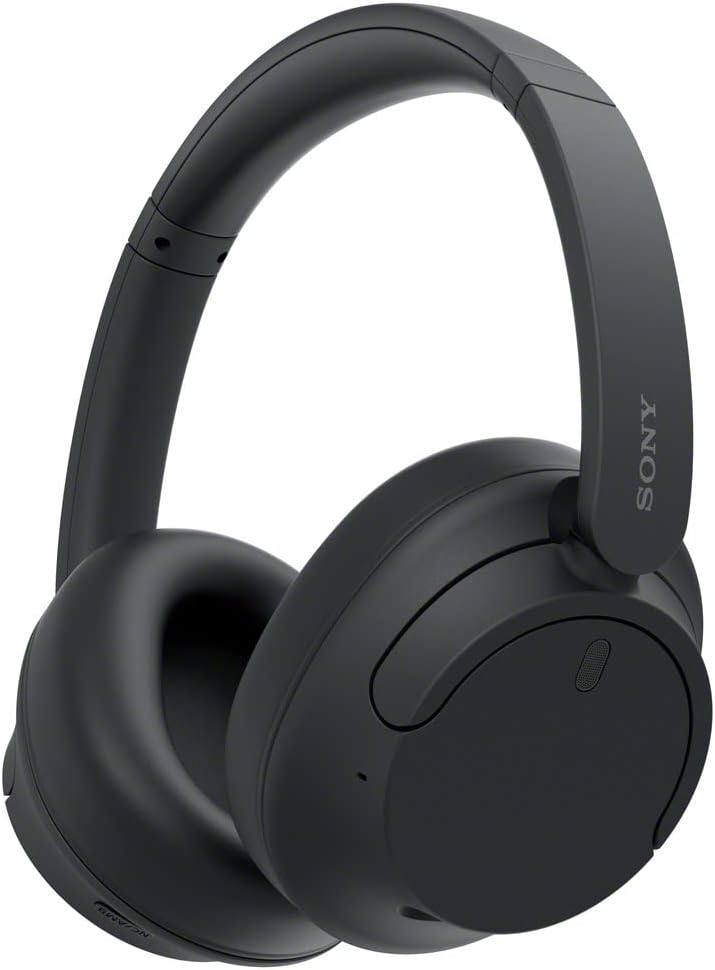
The Sony WH-CH720N is a sensible buy for a mixed day, and worth being blunt about: it is a lightweight over-ear, and Sony positions low weight and all-day comfort as selling points. As a general rule, a build tuned for light, loose-feeling wear tends to trade away some of the clamp and pad bulk that drive passive isolation, and passive isolation is the part that actually fights speech. If your entire problem is a loud open-plan floor, the ANC on this set will not fix it. What it will do is handle your bus or subway leg properly, stay comfortable long enough that you keep wearing it, and give you a platform for masking audio. Buy it for the commute and accept the office as a partial win.
The Soundcore Q20i sits in similar territory at a lower price, with the same caveat. Both are marketed as comfortable consumer ANC headphones rather than heavily clamping monitoring designs, so neither should be expected to make a nearby conversation vanish.
If chatter is genuinely the whole job, the honest answer is that a tightly clamping closed-back over-ear with no ANC at all, plus a brown-noise track, often outperforms a looser ANC model. ANC is a commute feature that happens to come along for the ride. Our roundup of cheap wireless headphones for commuting and the gym covers the travel case in more detail, and if you want to understand why sealed cups and bass response are linked, the evidence on bass-heavy headphones is a useful companion read.
Who should buy ANC headphones, and who shouldn't bother?
Buy them if you commute by plane, train, bus, or car, work near mechanical noise, or want quiet on a flight. That's the job ANC was built for, and it does it well.
Buy a well-sealing over-ear and skip ANC as a priority if your noise is people talking, phone calls at the next desk, or a café. Spend the budget on fit, pad quality, and comfort for long wear.
Don't expect either to solve the problem alone if you share a small room with a constant talker. No consumer headphone fully removes intelligible speech from a few feet away. At that point the fix is a schedule change, a different desk, or a conversation with a manager.
Specifications and claims here come from manufacturer-published material, and the acoustic points are general principles of how active cancellation operates rather than measurements of any specific unit.
Editor's Pick
Affiliate link. We may earn a commission if you buy through it, at no extra cost to you.
More from Our Editors
Do Cooling Pillows Actually Work for Hot Sleepers?
By ReviewHubNow Editorial Team
Gravity Water Dispenser vs Pet Fountain: Which to Buy
By ReviewHubNow Editorial Team
Do Fingerprint Smart Locks Need WiFi? What Works Offline
By ReviewHubNow Editorial Team