Best Cheap Wireless Headphones for Commuting and the Gym in 2026
Everyone assumes cheap headphones mean bad sound and dead batteries by lunch. A closer look at the market tells a different story entirely.
ReviewHubNow Editorial Team
ReviewHubNow Editorial Team
The standard advice in this category is that you get what you pay for, and that a budget pair of wireless headphones means accepting thin sound, weak cancellation and a battery that quits somewhere between the commute home and the evening workout.
The current market does not support that. Real differences remain between a budget pair and a flagship, and those differences sit somewhere other than where most buyers expect, and paying more does not solve the problems that actually ruin a commute or a session.
Do you need premium ANC for a train or a gym?
No, because the technology moved down-market. Active cancellation was genuinely a luxury feature reserved for expensive headphones several years ago. Hybrid ANC, which uses external and internal microphones together to model ambient noise, now appears in budget hardware because the chipsets became cheap to produce at volume.
The Soundcore Q20i illustrates this clearly. It runs hybrid cancellation at a price that once bought passive isolation alone, and listener reports consistently describe it competing well above its price against low-frequency drone: train rumble, HVAC hum, treadmill motors.
Where it falls short of flagship models is high-frequency chatter, meaning someone talking nearby. That limitation is worth understanding before spending more to fix it, because no headphone under roughly $150 handles conversation well, and expensive ones struggle with it too.
Cancellation quality plateaus faster than price does. Past the first step up from the cheapest tier, each additional dollar buys progressively less, which our guide to cancelling headphones under $100 covers in more detail.
Can budget headphones survive sweat and workouts?
Yes, and the concern made sense a decade ago when budget wireless headphones genuinely failed from sweat exposure through corroded contacts and moisture in the driver housing. IPX4 sweat and splash resistance is now standard even at the low end, and that rating covers everything short of running through a downpour.
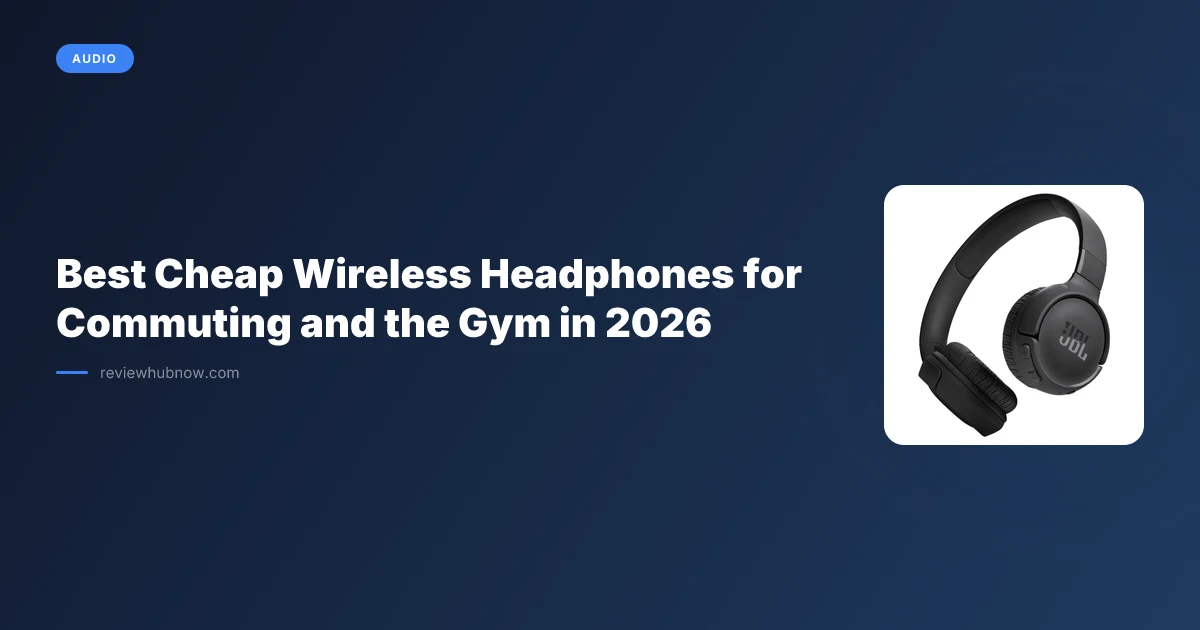
Fit, not durability, is the real gym problem with inexpensive headphones. Over-ear pairs shift during anything more dynamic than a treadmill walk, and on-ear designs such as the JBL Tune 520BT depend heavily on what you are doing. For steady cardio, cycling and commuting the 520BT sits securely and represents solid value.
Explosive movement is where it struggles, since burpees, heavy pulls and rapid head-angle changes let on-ear pads slide enough to distract mid-set. Training built around Olympic lifts, sprint intervals or skipping is better served by a secure in-ear or a firm-clamping headband for those sessions, even if the 520BT covers everything else.
What genuinely destroys budget headphones is not the gym at all. It is being left in a bag with a wet towel for days, and no IPX rating survives that.
Is bass-heavy tuning better for training?
Better for some sessions and worse for others, and the marketing blurs two separate claims. Bass-forward models such as the Skullcandy Crusher Evo lean on the idea that more low end produces more energy and intensity. There is something to that, since heavier bass correlates with perceived energy and can nudge effort slightly upward, which is why gyms play music with a strong beat.
More bass and better sound for training remain different claims. Boosted low end muddies vocal clarity, which matters when the commute audio is a podcast rather than a squat-rack playlist. It also drains battery faster because the drivers work harder, and it fatigues ears more quickly across a long session.
Our full review of the Crusher Evo goes through the research behind bass-heavy tuning. The summary: strong for lifting with an aggressive playlist, mediocre for most other listening. Buy it for what it does well rather than on the assumption that bass equals performance.
Should you trust the battery number on the box?
Not at face value. Those ratings are typically measured at moderate volume with cancellation switched off, which describes nobody's commute. Turn cancellation on and raise the volume enough to beat train noise, and runtime across most budget pairs falls well short of the advertised figure, with the size of the gap varying by model and use.
The Sony WH-CH720N is unusual for landing close to its claim, coming in only modestly below the marketed number with cancellation active. That consistency matters more to a daily commuter than a high peak figure, because a headphone quietly underdelivering every day turns into a recurring charging chore. Our Sony and Beats comparison covers the daily trade-offs between those two.
What should you actually buy?
Anyone splitting time between a commute and a gym is well covered by a mid-budget pair with hybrid cancellation and a secure fit. The remaining gap up to flagship models is largely personal fit preference rather than audio science.
Spending more makes sense if noise leakage genuinely bothers you or you need clarity for critical listening. Otherwise the premium buys marginal gains that most listeners cannot detect in a moving train or a loud weight room.
Condensed to one rule: buy for fit and cancellation performance in your specific environment, ignore the bass marketing, and discount the battery figure on the box.
Editor's Pick
Affiliate link. We may earn a commission if you buy through it, at no extra cost to you.

More from Our Editors
Hook-On High Chair vs High Chair for Small Apartment
By ReviewHubNow Editorial Team
Robot Vacuum Mop or Wet Dry Vacuum for Hard Floors?
By ReviewHubNow Editorial Team
Does Noise Cancelling Work for Office Chatter?
By ReviewHubNow Editorial Team