Anti-Aging Serums for Sensitive Skin: A Beginner's Buying Guide
Strongest is not best when your barrier is already compromised. Here is which active to start with, at what frequency, and why tolerability beats percentage.
ReviewHubNow Editorial Team
ReviewHubNow Editorial Team
This is not dermatological advice. This is editorial research rather than a professional consultation. Patch test new actives, and speak to a dermatologist if you have a skin condition, are pregnant, or react to a product.
The most common way to fail with anti-aging actives is to start at full strength. A high-percentage retinol applied nightly from day one, with no patch test, reliably produces flaking, stinging and redness that can take a couple of weeks to settle. Skin behaves like any other tissue under load: going from zero to maximum and expecting a good outcome does not work.
For sensitive skin the stakes are higher, because a compromised barrier loses water faster and lets irritants in more easily. That is a measurable characteristic rather than a preference, and it should shape the entire buying strategy.
Worth saying plainly: this is general research rather than dermatological advice. Persistent irritation, or any condition like rosacea or eczema, deserves a dermatologist rather than a shopping list.
Why does starting strong backfire?
Because results from actives depend on consistent tolerated use across months, not on how aggressive the first application is. Skin renewal is dose and frequency dependent, so a low-strength product used several nights weekly for three months outperforms a high-strength one used twice before irritation ends the experiment.
That reframes the percentage on the label. A higher number is not a measure of how good a product is, it is a measure of how much adaptation your skin needs to tolerate it. For a beginner with a reactive barrier, tolerability is the specification that determines whether you get results at all.
Which active should sensitive skin start with?
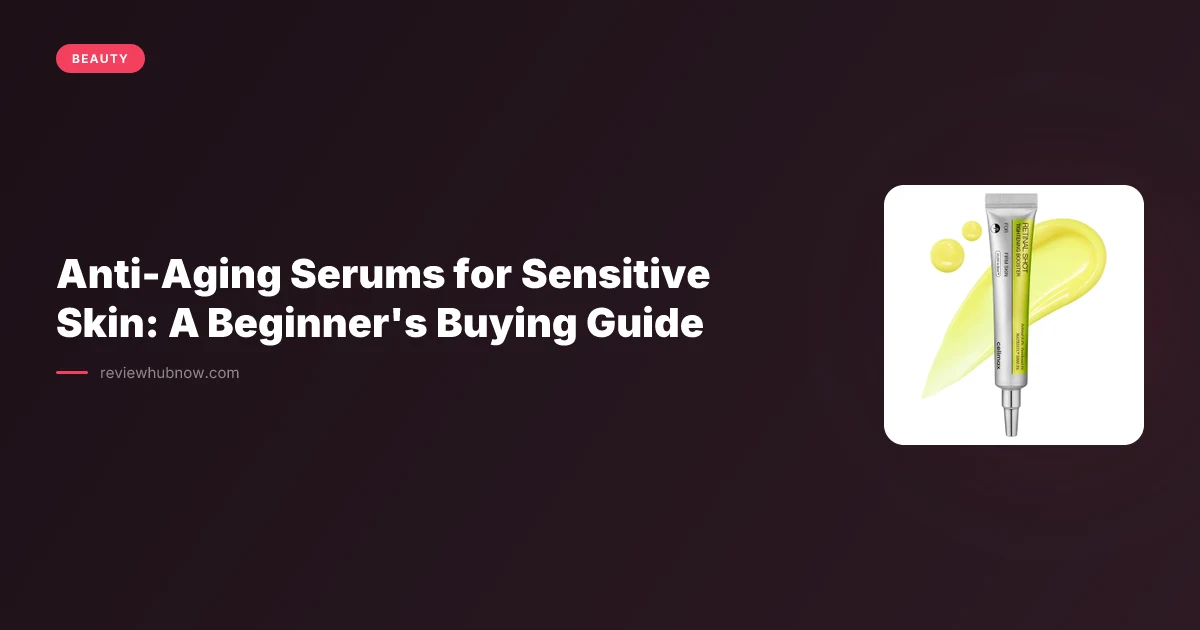
Retinaldehyde is the sensible first choice. It converts to retinoic acid, the form that actually does the work, in fewer steps than retinol, which means comparable effects at lower concentrations and typically less irritation. Concentrations around 0.05% to 0.1% are a reasonable starting range.
Unbuffered high-percentage vitamin C is close to the worst starting point for this skin type. L-ascorbic acid needs a low pH to stay stable, and that acidity is precisely what triggers stinging and flushing on a compromised barrier. Buffered or derivative forms are gentler, with a trade-off in potency.
Peptide serums are the gentlest option and also the least evidenced for visible change. They are a reasonable choice for someone who cannot tolerate retinoids at all, and a poor substitute for someone who could.
Whatever you choose, start with a single active. Combination serums stacking retinol, vitamin C and peptides in one bottle are convenient and make it impossible to identify what caused a reaction.
How do you reduce irritation from retinoids?
Buffering works, and it is not a gimmick. Applying moisturizer before the serum, or immediately after, dilutes contact with the active and reduces irritation substantially without meaningfully reducing the benefit. The so-called sandwich method is simply this principle applied in both directions.
Frequency matters more than most beginners expect. Two nights a week for the first fortnight, then three, then four, is the schedule that determines whether someone is still using actives in month three or gave up in week two. There is no prize for nightly use in the first month.
Avoid fragrance and essential oils in anything containing an active. They contribute nothing functional and are among the most common triggers for sensitive-skin reactions.
Does sunscreen matter when using retinoids?
It is not optional. Retinoids increase photosensitivity, and ultraviolet exposure is the largest single driver of the visible aging these products aim to address. Using a retinoid without daily sunscreen undoes the work you are paying for while making the skin more vulnerable in the meantime.
Daily broad-spectrum SPF is the highest-value step in any anti-aging routine, ahead of every serum discussed here. Anyone unwilling to wear it consistently should address that before buying actives.
How long before you see results?
Six to eight weeks of consistent use before judging anything, and months before texture and fine line changes become apparent. That timeline is unglamorous and it is what the evidence supports.
The most common self-inflicted failure is switching products every few weeks in search of faster change, which resets the clock each time. Choose the gentlest formulation of a well-studied active, use it at a frequency your skin tolerates, and let it run.
Anyone whose concern is firmness and elasticity rather than fine lines should read our piece on anti-aging boosters for loose skin first, since collagen support and cell turnover are related problems that do not respond equally to the same ingredients. Our reality check on retinal boosters covers what tightening claims genuinely deliver, which is modest improvement over months rather than the transformation the marketing implies.
Editor's Pick
Affiliate link. We may earn a commission if you buy through it, at no extra cost to you.

More from Our Editors
Hook-On High Chair vs High Chair for Small Apartment
By ReviewHubNow Editorial Team
Robot Vacuum Mop or Wet Dry Vacuum for Hard Floors?
By ReviewHubNow Editorial Team
Does Noise Cancelling Work for Office Chatter?
By ReviewHubNow Editorial Team