Anti-Aging Boosters for Loose Skin in Your 30s and 40s: The Evidence
Loose skin is several problems at once, which is why most tightening products underdeliver. Here is what the clinical research supports and what to skip.
ReviewHubNow Editorial Team
ReviewHubNow Editorial Team
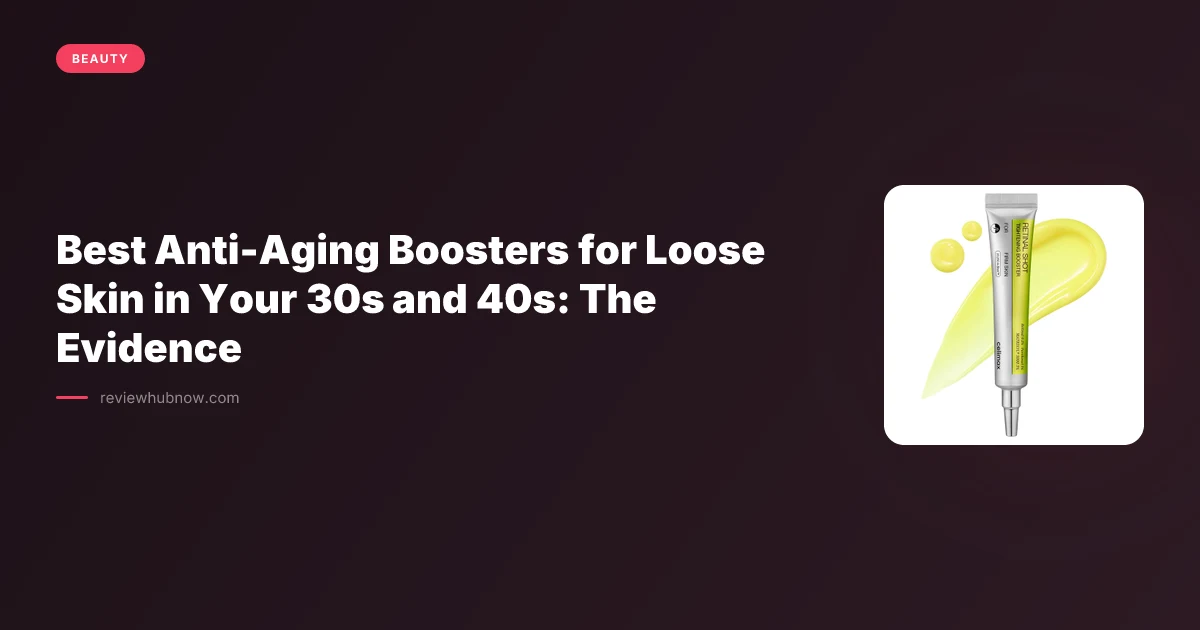
This is not dermatological advice. This is editorial research rather than a professional consultation. Patch test new actives, and speak to a dermatologist if you have a skin condition, are pregnant, or react to a product.
Loose skin turns otherwise sceptical people into buyers of implausible products. Fine lines get treated realistically, and the moment skin loses definition along the jaw or bounce at the neck, anything labelled tightening starts looking appealing.
The confusion comes from treating it as one problem. Loose skin is collagen and elastin degrading, fat pads shifting position, and the skin's structural scaffolding weakening, all proceeding at once at different rates. So the question to ask any product claiming to fix it is which part of that it addresses. Most do not say, because most cannot.
This is a research summary rather than dermatological advice, and anything involving prescription-strength treatment or a procedure belongs in a conversation with a dermatologist.
What has the strongest evidence for firmness?
Retinoids, by a wide margin and not by a small one. Tretinoin, retinaldehyde and to a lesser extent over-the-counter retinol have repeated published studies showing increased collagen production and improved skin thickness and elasticity across months of consistent use. Dermatology journals have documented this since the 1980s, which makes it one of the best-supported claims in all of skincare.
The part rarely mentioned at purchase is the timeline. Meaningful change takes around twelve weeks minimum, and the first three or four weeks frequently look worse rather than better, with flaking and redness while skin adapts. Most people who abandon retinoids quit during that window, shortly before the benefit would have appeared.
For loose skin specifically, retinaldehyde formulations tend to be gentler than prescription tretinoin while still driving genuine collagen work, which matters when skin is already thinning and reactive. Our guide to serums for sensitive skin covers how to introduce one without the irritation that ends most attempts.
Do peptides and growth factors work?
Modestly for peptides, and the evidence for growth factors is not yet there. Some peptide chains, including copper peptides and certain signal peptides, have small clinical trials reporting improvements in firmness and collagen signalling. Modest is the operative word, since these are not retinoid-level results and work better as a supporting ingredient than as the foundation of a routine.
Growth factor serums attract heavy marketing on preliminary research, typically small studies frequently funded by the companies selling the product. That does not mean they do nothing. It means the evidence does not currently justify the premium prices attached to them.
An inexpensive peptide serum at a reasonable concentration is a sensible addition alongside a retinoid. It should not be expected to carry the routine.
Do collagen supplements actually improve skin?
The data is better than sceptics expect and weaker than the marketing claims. Several randomised controlled trials of hydrolysed collagen peptides report improved skin elasticity and hydration after eight to twelve weeks of daily use, with small to moderate effect sizes.
That makes it one of the few ingestible options with genuine trial data behind it rather than testimonials alone. It also will not reverse loose skin by itself. Typical study doses fall in the range of 2.5 to 10 grams daily of hydrolysed peptides, and it works best understood as a supplement to topical treatment rather than a replacement for it.
Are microneedling and red light therapy worth it?
In-office microneedling has solid evidence for firmness improvement. At-home rollers are a different proposition, because needle depth determines whether the treatment triggers collagen remodelling or merely irritates the surface, and consumer devices generally cannot reach professional depths. There is also a genuine infection risk with poor technique or hygiene, which makes this the one category here worth approaching cautiously.
Red light therapy has a growing and reasonable body of evidence for improving firmness and collagen density with consistent use several times weekly across months. It is slow and undramatic, and it is not pseudoscience. As an addition to an existing routine it is legitimate, provided it is not expected to replace retinoids.
What should you ignore?
Firming creams promising visible lifting within days are describing something skin cannot do, since structural change happens over months. Topical products claiming to boost elastin deserve particular scepticism, because elastin production is notoriously difficult to stimulate and no consumer product has credibly demonstrated it.
Essential oil blends marketed for tightening have neither a plausible mechanism nor trials behind them.
What does an evidence-based routine look like?
Built from the research alone: a tolerable retinoid used consistently at night, broad-spectrum sunscreen every day without exception, a hydrolysed collagen supplement if you want an oral option, and red light therapy if it fits your budget and schedule.
Sunscreen deserves emphasis, because ultraviolet exposure degrades collagen faster than any of these interventions rebuild it. Skipping it while spending on serums is working against yourself.
Everything beyond that list is optional. Skin in your thirties and forties is not broken, it responds more slowly, which means consistency beats novelty and the unglamorous routine outperforms the expensive one nearly every time.
Editor's Pick
Affiliate link. We may earn a commission if you buy through it, at no extra cost to you.

More from Our Editors
Hook-On High Chair vs High Chair for Small Apartment
By ReviewHubNow Editorial Team
Robot Vacuum Mop or Wet Dry Vacuum for Hard Floors?
By ReviewHubNow Editorial Team
Does Noise Cancelling Work for Office Chatter?
By ReviewHubNow Editorial Team