Budget Noise-Cancelling Headphones for Gaming: Worth It Under $100?
Most budget ANC headphones weren't built for gaming, and the mismatch will cost you more than $100 in frustration. Here's how to actually buy right.
ReviewHubNow Editorial Team
ReviewHubNow Editorial Team
A common and expensive mistake: reading a best noise-cancelling headphones list, buying whatever ranks highest, plugging it into a gaming setup, and discovering that footsteps in a shooter sound like they are arriving through a pillow. The list was not wrong, it was written for a different purpose. Cancelling headphones and gaming headphones solve different problems, and below $100 the overlap is narrower than the marketing implies.
Budget cancelling headphones can work for gaming. Working and working well without adjustment are separate claims, and the difference comes down to a few specifications people rarely check.
What problem are you actually solving?
Be specific about why you want cancellation. Living with housemates, a television in the next room or a busy street calls for aggressive, consistent noise reduction.
Competitive play is a different requirement entirely, where cancellation is nearly irrelevant and what matters is a wide soundstage and low latency. Inexpensive cancelling headphones are usually tuned for bass-heavy music rather than directional accuracy, which works against positional awareness.
Deciding which of those you are optimising for determines everything that follows.
Does Bluetooth latency matter for gaming?
Enormously, and almost nobody checks it before buying, which makes it the leading cause of disappointment here. Standard Bluetooth audio carries roughly 100 to 220 milliseconds of delay depending on codec and chipset, enough in a fast shooter for a gunshot to arrive after you have already died on screen.
Some budget headphones now offer a low-latency or game mode that brings this down substantially, into playable territory though still behind a wired connection, which runs in single-digit milliseconds.
Anyone gaming as the primary use case, without a dedicated low-latency dongle, should look specifically for a stated game mode or plan to use the wired input when timing matters.
Is immersive soundstage marketing real?
Rarely at this price. Nearly every box promises immersive, spatial or 3D sound, and most of it is equalisation and reverb applied to ordinary stereo drivers rather than genuine spatial audio.
What genuinely helps positional awareness is a flatter frequency response with clear mids, not the scooped bass-forward tuning most budget cancelling headphones ship with, since that tuning sells well for music and commuting.
Where a companion app offers adjustable equalisation, use it. Flattening the low end alone resolves much of the muddiness that makes footstep direction hard to place.
What can cancellation at this price actually block?
Low, constant frequencies: HVAC hum, traffic drone, a fan in the next room. It will not erase a housemate's voice, a barking dog or nearby typing, because that needs better microphone arrays and processing than budget hardware carries.
Our breakdown of what sub-$100 cancellation blocks covers this in more detail. Expect substantial reduction in ambient drone rather than silence.
How good are the built-in microphones?
Generally poor, and this is the weak point for anyone playing with a squad. Cancellation quality and microphone quality do not improve together at this price, because manufacturers spend the budget on the cancellation chip and treat the microphone as secondary.
Test a voice call within the first week while a return is still possible. A thin, heavily compressed microphone is common enough in this bracket to be the expectation rather than the exception.
Will they stay comfortable for long sessions?
Judge that on hour three rather than on first impression, since a headset that feels fine briefly can become a clamp across a long session. Check clamping force, ear cup padding depth and total weight, since heavier designs make themselves known after a couple of hours.
Over-ear designs generally beat on-ear for extended gaming, because on-ear pads press directly against the ear rather than surrounding it.
Which should you buy?
Gaming first, with occasional music and calls, points to a headphone with a documented low-latency mode and an adjustable equaliser, even where its cancellation figures are not class-leading.
Blocking noise first, with gaming secondary, points the other way: prioritise cancellation and accept the latency trade-off. Our commuting and gym picks mostly fall into that second group, strong at tuning out the world and mediocre for competitive timing.
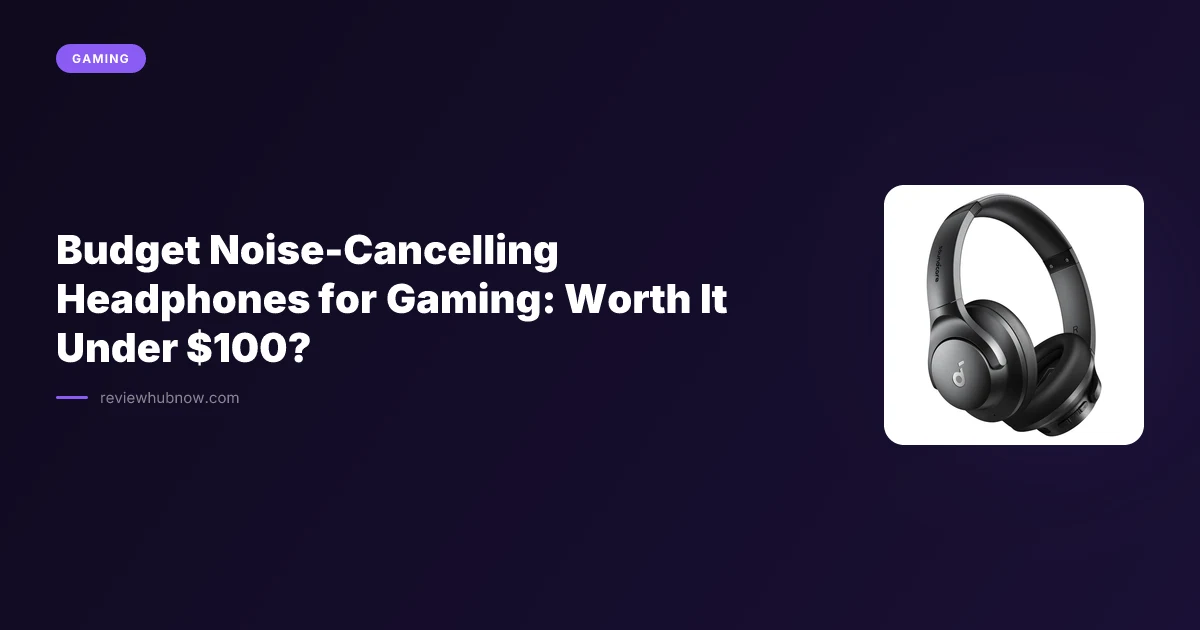
The Soundcore Q20i suits this use case as well as anything under $100. Its hybrid cancellation handles ambient drone better than most at the price, the companion app allows flattening the bass-heavy default tuning, and it stays comfortable across long sessions in a way cheaper on-ear designs do not. It will not match a dedicated gaming headset on latency or microphone clarity, and for someone splitting time between gaming, calls and a noisy house it is the sensible choice in this bracket.
Budget cancelling headphones are worth buying for gaming when you check latency, tuning and microphone quality first. They disappoint when bought on the assumption that strong cancellation reviews automatically make a gaming headset. Test everything within the return window, and send it back if it leaves you behind in every gunfight.
Editor's Pick
Affiliate link. We may earn a commission if you buy through it, at no extra cost to you.

More from Our Editors
Hook-On High Chair vs High Chair for Small Apartment
By ReviewHubNow Editorial Team
Robot Vacuum Mop or Wet Dry Vacuum for Hard Floors?
By ReviewHubNow Editorial Team
Does Noise Cancelling Work for Office Chatter?
By ReviewHubNow Editorial Team