Convertible Car Seat Setup That Reduces Kids' Motion Sickness
The seat brand matters less than most parents think. What actually cuts carsick meltdowns on road trips comes down to orientation, height, and recline angle.
ReviewHubNow Editorial Team
ReviewHubNow Editorial Team
This is not medical advice. This is editorial research, not a clinical recommendation. Talk to your doctor or pharmacist before starting, stopping, or changing any supplement or medical product, especially if you take medication or manage a health condition.
Parents shopping for a convertible car seat sometimes hope one model will stop the road-trip vomiting, and some marketing pages come close to implying certain seats have anti-nausea engineering in them. They do not. What reduces motion sickness in children has little to do with the brand and a great deal to do with how the seat is positioned, angled and used.
Motion sickness is a sensory mismatch. The inner ear registers the car turning, braking and accelerating while the eyes, particularly for a child sitting low with a view of nothing but the door panel, report that nothing is moving. That conflict triggers nausea, and it is the same mechanism that makes adults queasy reading in a moving car. Children are affected more strongly because their vestibular systems are still developing and they usually sit lower with a worse sightline than an adult in front.
So the fix is not a particular seat. It is narrowing that visual and vestibular gap as far as your seat and setup allow.
Does forward-facing reduce car sickness?
Often yes, and that is not a reason to turn a child around early. Rear-facing is the safer orientation for younger children and stays non-negotiable regardless of nausea, even though seeing less of the road ahead does tend to make motion sickness worse.
Once a child genuinely reaches the height and weight thresholds for forward-facing in your specific seat, the transition frequently reduces sickness on its own, because they can finally see through the windshield and track the horizon. Make that change on the seat's actual limits rather than a rule of thumb from a parenting forum. Our guide to what actually matters in car seat safety covers when each transition is genuinely appropriate.
Why does seat height matter more than features?
Because sightline is the whole problem. A seat that positions a child higher relative to the window line gives them moving horizon, trees and buildings, which are exactly the visual cues that match what the inner ear reports. A seat that leaves a toddler below the window sill sets up trouble on any drive longer than about twenty minutes.
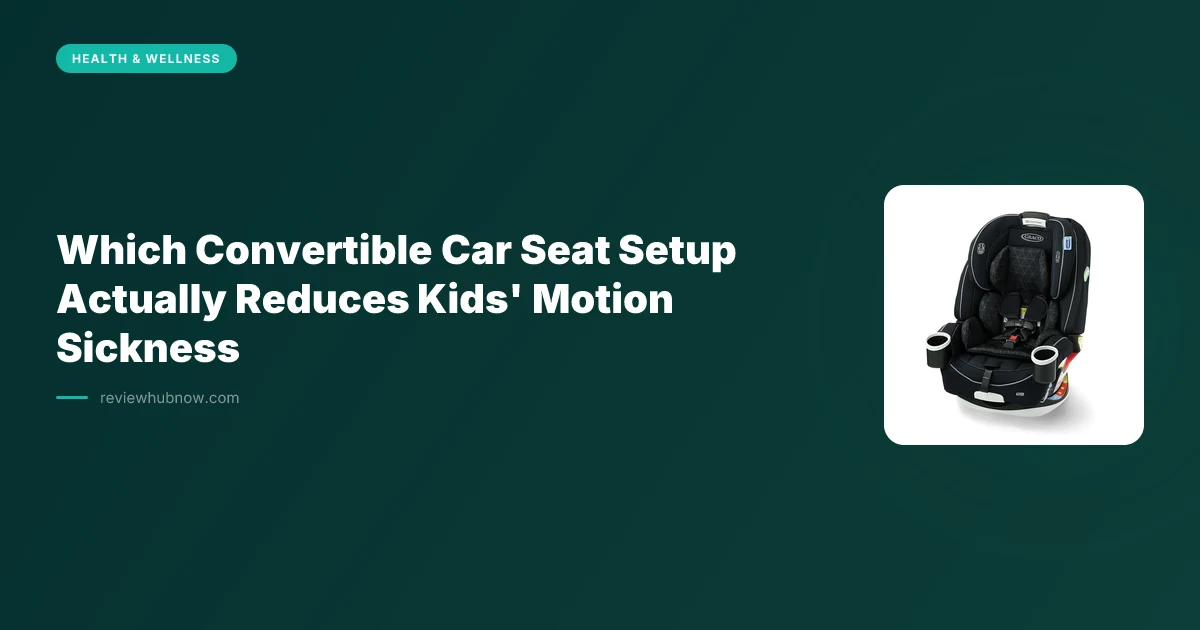
That makes multiple height positions and a taller shell genuinely useful specifications, and the Graco convertible is a reasonable example of a seat offering both. No manufacturer markets this as an anti-nausea feature, and functionally it does that job.
How often should you check the recline angle?
More often than once. Most parents set the recline at installation and never revisit it, which stops matching the child as they grow and their neck strength changes.
Too reclined and a younger child's head lolls sideways, which adds to the disorientation. Too upright for an older child and they strain to see out, which pushes their focus back onto the car's interior and makes the mismatch worse rather than better. Check the seat's recline indicator against your child's current size every few months rather than treating installation day as final.
Do tablets make car sickness worse?
Considerably, and this is the most common well-intentioned mistake, because a quiet child feels like a victory. Near-focus visual tasks accelerate motion sickness: the eyes lock onto something stationary relative to the body while the vestibular system keeps reporting movement, which is precisely the conflict causing the nausea, amplified.
Audio creates no such conflict. Audiobooks, podcasts and music through kid-sized wireless headphones keep a child entertained without forcing their eyes to a fixed near point while the car moves underneath them. Looking out the window at the horizon is better still, and audio is the realistic compromise on a long drive.
When should you stop on a long drive?
Before the symptoms arrive rather than after. Motion sickness builds across a trip instead of striking instantly, so a child who reliably turns queasy around the ninety-minute mark needs a break at sixty, not at the first complaint.
Five minutes of fresh air and a short walk helps, and so does food if it has been a while, since an empty stomach worsens nausea rather than protecting against it, contrary to what many parents assume. Waiting until a child looks visibly unwell means the window where a break would have helped has already closed.
Does ventilation actually help?
Yes, more than its simplicity suggests. A warm, stuffy cabin worsens nausea independently of the visual and vestibular mismatch, so heat and stale air stack on top of the underlying problem.
Open a window, direct a vent toward the back seat and keep the rear cabin cooler rather than cosy. It is the cheapest intervention available and frequently the one that produces a noticeable difference.
What should you look for when buying?
Shopping with motion sickness in mind means prioritising a genuinely adjustable recline range, a taller shell and multiple height positions over vague comfort language and cup holders.
No seat cures a sensitive vestibular system. A well-chosen one stops making the situation worse, and that distinction matters a great deal when you are four hours into a drive with a child who has already mentioned their stomach twice.
None of this advice is glamorous. It is setup discipline: checking angles, choosing sightline over cosmetics, and swapping tablets for audio. It is also what actually moves the needle, and it costs nothing beyond attention you were going to spend on the trip anyway.
Editor's Pick
Affiliate link. We may earn a commission if you buy through it, at no extra cost to you.

More from Our Editors
Hook-On High Chair vs High Chair for Small Apartment
By ReviewHubNow Editorial Team
Robot Vacuum Mop or Wet Dry Vacuum for Hard Floors?
By ReviewHubNow Editorial Team
Does Noise Cancelling Work for Office Chatter?
By ReviewHubNow Editorial Team