Sleep Tracking Pad vs. Smartwatch in Bed: What the Data Says (2026)
Under-mattress pads and smartwatches use completely different methods to guess how you slept. Here's what the validation research actually shows about accuracy.
ReviewHubNow Editorial Team
ReviewHubNow Editorial Team
This is not medical advice. This is editorial research, not a clinical recommendation. Talk to your doctor or pharmacist before starting, stopping, or changing any supplement or medical product, especially if you take medication or manage a health condition.
Everyone with a smartwatch now wakes up to a sleep score. A number from 0 to 100, a pie chart of stages, maybe a little cartoon battery telling you how "ready" you are. The problem is that most people have no idea how that number gets generated, and the two dominant approaches on the market, under-mattress pads and wrist-worn wearables, measure your body in fundamentally different ways. That's a big part of why the reviews and the marketing copy contradict each other so much. Nobody's lying exactly. They're just measuring different things and calling it all "sleep tracking."
How does a sleep tracking pad actually measure sleep?
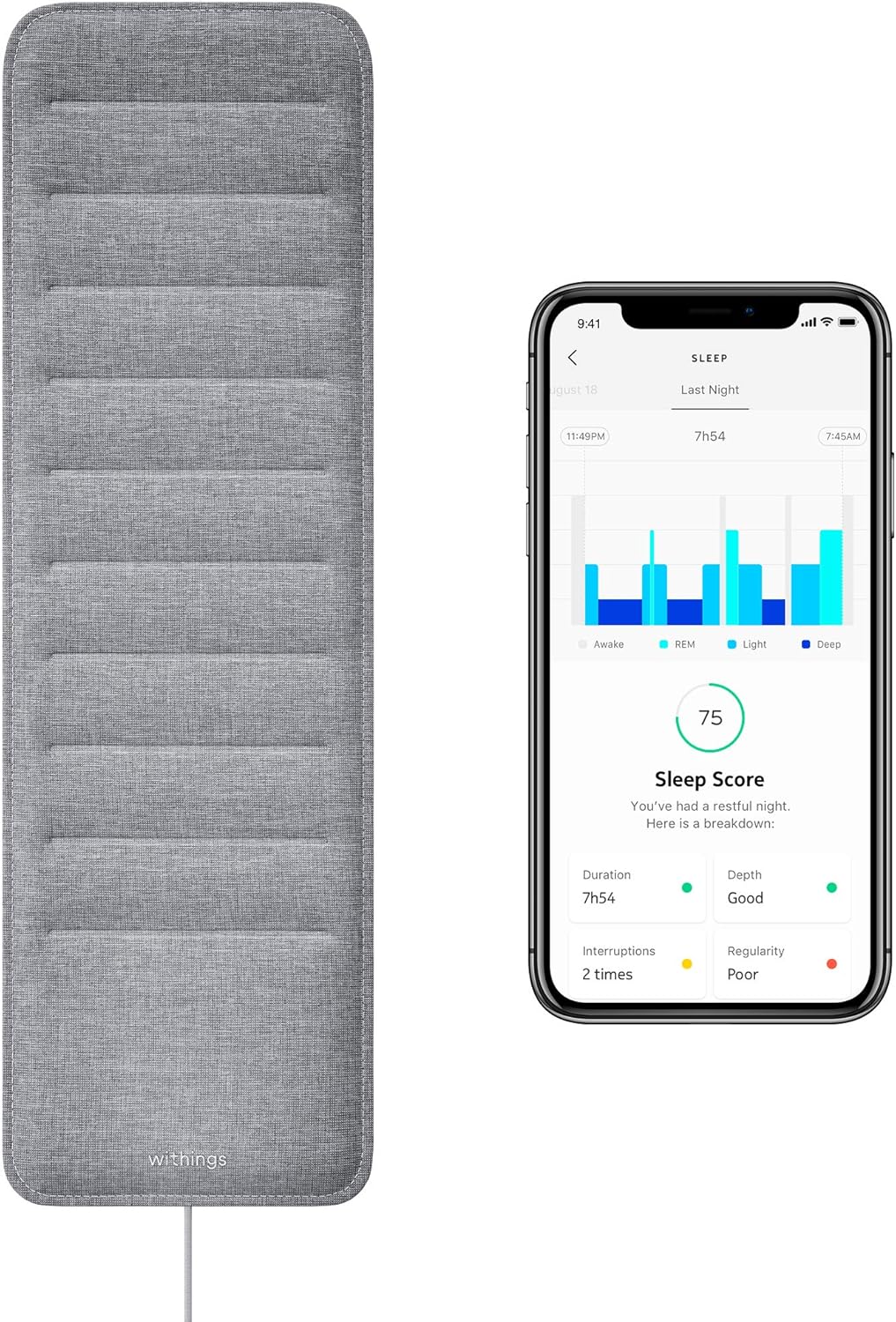
Under-mattress pads like the Withings Sleep Tracking Pad use a technology called ballistocardiography. A thin sensor strip goes under your mattress and picks up the micro-movements your body makes with every heartbeat and every breath. No contact with your skin, nothing to strap on. The device is estimating sleep state from the vibration pattern your circulatory and respiratory systems create against the mattress surface.
That's a clever workaround for the biggest complaint about wearables: nobody wants to sleep with a piece of hardware clamped to their wrist. But ballistocardiography has a real limitation. It struggles with couples sharing a bed, pets that jump on the mattress, and anyone whose sleep involves a lot of tossing that isn't actually a wake event. The sensor is inferring cardiac and respiratory rhythm from noise, and noise from a second body in the bed is a genuine confound, not a minor asterisk.
How does a smartwatch estimate sleep stages?
Wearables rely primarily on actigraphy, tracking movement via accelerometer, combined with photoplethysmography for heart rate and heart rate variability. The device isn't watching your brain waves. It's pattern-matching your movement and pulse against algorithms trained on populations of other people's polysomnography data, then guessing which stage you're probably in.
This matters because the gold standard for sleep staging, polysomnography (PSG), directly measures brain activity, eye movement, and muscle tone in a sleep lab. Every consumer device on the market, pad or wrist, is an indirect proxy for that. None of them are reading your brain.
What does the validation research actually show?
Here's where you separate signal from marketing. A number of published comparisons between consumer wearables and PSG in sleep labs point to a consistent pattern, even if exact numbers vary study to study and device to device: total sleep time and basic wake detection tend to be reasonably solid, generally holding up well against the lab standard. Sleep stage classification is a different story. Across published validation work, agreement on deep sleep and REM detection in consumer devices tends to land somewhere in the "moderate" range rather than anything close to precise, which is a lot less confident than the app's colorful chart implies. Wearables tend to overestimate light sleep and underestimate how much time you actually spend awake after falling asleep, because brief arousals that don't involve rolling over or a heart rate spike are nearly invisible to accelerometer-based tracking.
Under-mattress pads simply haven't been put through the same volume of independent testing that wrist wearables have. That's not a knock on the technology so much as an observation about how much research exists to check it against. What research does exist on ballistocardiography-based systems suggests comparable total sleep time accuracy to wearables, with similar or slightly worse staging precision, and a noticeable drop-off in accuracy for anyone sharing a bed. If you sleep solo, the pad tends to hold up. If you don't, take its stage breakdown as directional, not literal.
Is a higher "sleep score" actually meaningful?
This is the part worth questioning most. The proprietary readiness and recovery scores that every brand slaps on top of the raw data are largely unvalidated black boxes. They're built from a blend of sleep duration, heart rate variability, and resting heart rate, run through an algorithm the company won't publish. There's nothing wrong with using a score as a rough trend line over weeks. There's a real problem with treating a single night's number as diagnostic information. A 62 instead of your usual 78 doesn't tell you what went wrong. It tells you something changed, and you already knew that from how you felt getting out of bed.
Does wearing a device to bed disrupt the sleep you're trying to measure?
Nobody talks about this enough. A tight wrist strap can affect blood flow readings and, for some people, becomes a physical annoyance that fragments sleep on its own. That's the actual case for the under-mattress pad: it removes the observer effect entirely. You're not adjusting your sleep behavior around a piece of gear you can feel. If your own anxiety about "getting good data" is keeping you up, that's a real and underrated reason to go with something contactless.
So which one should you actually buy?
If you sleep alone and want the most detail on heart rate trends throughout the night, and you don't mind a strap, a smartwatch gives you more granular continuous data and doubles as daytime activity tracking. If you share a bed, hate wearing anything to sleep, or you've noticed your watch itself is part of what's bothering you at night, a pad like the Withings is the better fit, with the caveat that a partner in the bed will muddy its readings.
Neither one fixes anything by itself. That's the part the marketing conveniently skips. A tracker tells you a trend; it doesn't change your sleep environment, your caffeine cutoff, or a partner's snoring keeping you at a lighter stage all night. If disrupted sleep from a partner's snoring is the real issue showing up in your data, the fixes that actually work without earplugs are worth more than another week of tracking. And if what your data is really telling you is that you're cold, hot, or unsupported all night, that's a mattress and bedding problem no algorithm solves, which is where something like picking the right weighted blanket actually moves the needle.
One more thing worth saying plainly: none of this replaces a sleep study if you're waking up gasping, your partner says you stop breathing, or you're exhausted despite eight hours logged every night. That's a conversation for a doctor, not a firmware update. Consumer trackers are good for spotting patterns over time. They are not built, tested, or intended to diagnose sleep apnea or any other sleep disorder.
If you just want a reliable trend line on your sleep duration and consistency without strapping anything to your body, the pad earns its keep. If you want the fuller physiological picture and don't mind the wrist strap, the watch still wins on data depth. Buy based on which trade-off actually fits how you sleep, not which one has the shinier app.
Editor's Pick
Affiliate link. We may earn a commission if you buy through it, at no extra cost to you.
More from Our Editors
Hook-On High Chair vs High Chair for Small Apartment
By ReviewHubNow Editorial Team
Robot Vacuum Mop or Wet Dry Vacuum for Hard Floors?
By ReviewHubNow Editorial Team
Does Noise Cancelling Work for Office Chatter?
By ReviewHubNow Editorial Team