B12 at 2500mcg vs 5000mcg: What the Dosing Research Actually Shows
The RDA is 2.4mcg, so why do bottles say 2500mcg or 5000mcg? Here's what absorption research actually says about which dose you need.
ReviewHubNow Editorial Team
ReviewHubNow Editorial Team
This is not medical advice. This is editorial research, not a clinical recommendation. Talk to your doctor or pharmacist before starting, stopping, or changing any supplement or medical product, especially if you take medication or manage a health condition.
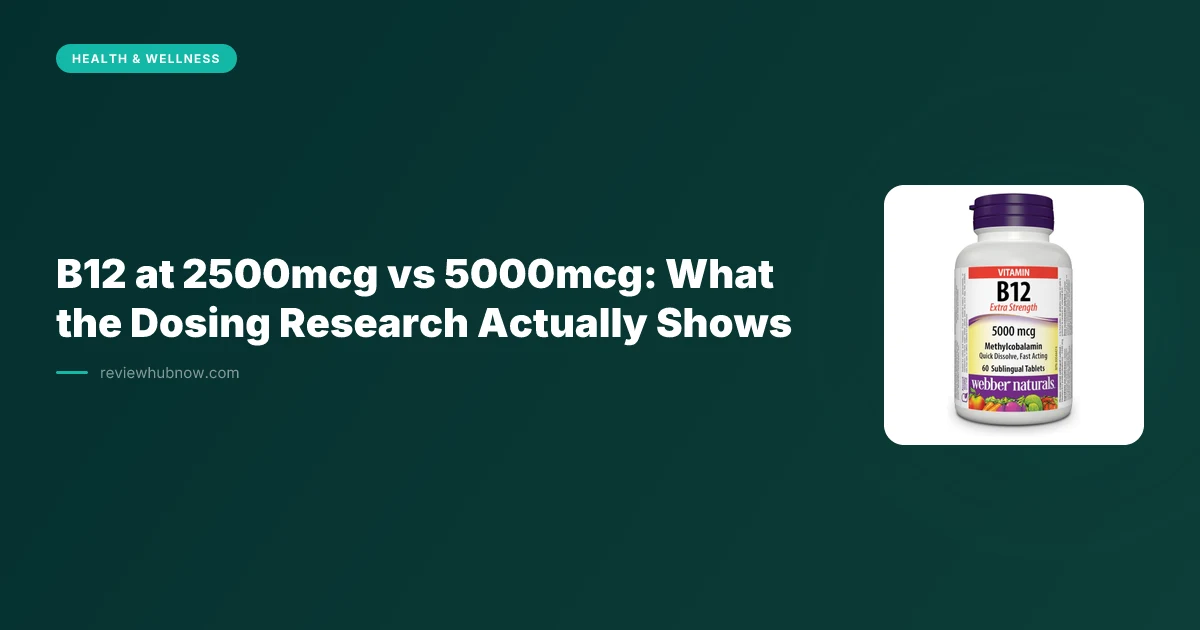
Walk down the supplement aisle and you'll see B12 bottles at 1000mcg, 2500mcg, and 5000mcg, sitting next to each other like they're interchangeable. Then you look up the official recommended intake and find it's 2.4 micrograms a day for adults. Not milligrams. Micrograms. That's a gap of over 1,000x between what your body technically requires and what the bestselling bottle on the shelf contains, and nobody selling you the bottle is explaining why.
This isn't a scam, exactly. But it is a case where the marketing has run way ahead of the average person's understanding of how B12 actually gets into your bloodstream. Once you understand the absorption mechanism, the 2500 vs 5000 question mostly answers itself, and it's not the question most people think they're asking.
Why does the RDA say 2.4mcg when supplements sell 1,000x that?
Your body absorbs B12 two different ways, and this is the part almost no product label mentions. The primary pathway uses a protein called intrinsic factor, produced in your stomach, which binds B12 and shuttles it through your small intestine. That pathway is efficient, but it's also capped. Research on B12 pharmacokinetics has shown the intrinsic factor system can only process roughly 1.5 to 2 micrograms of B12 per meal, regardless of how much is present. Eat a steak with 3mcg of B12 in it, and your body absorbs close to all it can use through this route and moves on.
The second pathway is passive diffusion, and it works completely differently. It doesn't need intrinsic factor at all, but it's wildly inefficient, absorbing roughly 1% of whatever dose is sitting in your gut. This is the entire reason megadose B12 tablets exist. A 1000mcg tablet delivers maybe 10mcg through passive diffusion. A 2500mcg tablet gets you a bit more. A 5000mcg tablet, a bit more still. But the relationship isn't linear, and beyond a certain point you're paying for B12 that's leaving through the same door it came in.
Does 5000mcg actually absorb more than 2500mcg?
In absolute terms, yes, modestly. Passive diffusion scales roughly with dose, so a larger tablet does push slightly more B12 into circulation. But the difference between 2500mcg and 5000mcg is nowhere near proportional to the price difference between those bottles, and for most people it's a distinction without a practical consequence.
Here's the study that actually settles this for the population where it matters most: research on oral B12 replacement in pernicious anemia patients (people whose intrinsic factor system doesn't work at all) found that daily oral doses in the 1000 to 2000mcg range corrected B12 deficiency and normalized blood levels just as effectively as monthly intramuscular injections. That's the study that quietly justified the entire megadose oral B12 category. If passive diffusion alone can fix a total intrinsic factor failure at 1000-2000mcg, then for someone with a working digestive system and a mild dietary shortfall, 2500mcg is already overkill, and 5000mcg is overkill with a bit more margin built in.
Who actually needs the higher end of that range?
The honest answer: people whose absorption is already compromised. That includes anyone with pernicious anemia, anyone who's had gastric bypass or sleeve surgery, long-term metformin users (it measurably lowers B12 over years of use), people on chronic PPI or H2 blocker therapy, and older adults, since stomach acid production declines with age and acid is what liberates B12 from food in the first place. For this group, relying entirely on passive diffusion makes the higher-dose tablets a genuinely reasonable choice, not just a marketing upsell.
If none of that applies to you and you're just someone eating a normal omnivorous diet, you're very likely not deficient at all, and no amount of extra B12 is going to give you more energy than you already have. That's a claim worth being blunt about, because it's the one driving most of these purchases. We've covered this pattern before when looking at which energy supplements have real evidence behind them, and B12 for a non-deficient person consistently falls into the "won't hurt, won't help" category.
Does the form (sublingual, quick-dissolve, injection) actually change anything?
Marginally, and mostly not in the way it's marketed. Sublingual tablets are sold on the idea that B12 gets absorbed directly through the tissue under your tongue, skipping digestion entirely. The research on this is thin and mixed. Some small trials show sublingual and oral tablets perform about the same, since a good chunk of a "sublingual" tablet still gets swallowed and absorbed the standard way regardless. If you have trouble swallowing pills, quick-dissolve formats are convenient. They're not a superior delivery mechanism backed by strong evidence.
Injections are a different story, and they matter for people with severe, diagnosed deficiency or intrinsic factor failure where oral absorption can't be trusted to keep pace, but that's a conversation to have with a doctor, not a decision to make from a supplement aisle.
What I'd actually recommend
For most healthy adults without a diagnosed deficiency or risk factor, 1000 to 2500mcg daily is plenty, and it's the dose with the clearest evidence trail behind it. If you're in one of the higher-risk groups (age 60+, metformin, gastric surgery history, diagnosed low B12), the 5000mcg option gives you a wider margin and there's no meaningful downside since B12 is water-soluble and excess clears through urine rather than accumulating.
What I wouldn't do is buy the biggest number on the shelf assuming it means more energy, because that's not what the mechanism supports. And if you're feeling persistently fatigued, foggy, or numb in your hands and feet, that's a bloodwork conversation with a doctor before it's a supplement decision. A basic B12 and complete blood count panel is cheap, fast, and it's the only way to know whether you're actually deficient or just tired for one of the other hundred reasons people get tired.
Editor's Pick
Affiliate link. We may earn a commission if you buy through it, at no extra cost to you.

More from Our Editors
Hook-On High Chair vs High Chair for Small Apartment
By ReviewHubNow Editorial Team
Robot Vacuum Mop or Wet Dry Vacuum for Hard Floors?
By ReviewHubNow Editorial Team
Does Noise Cancelling Work for Office Chatter?
By ReviewHubNow Editorial Team