What Our Research Found
One question drove this review: is adjustable haptic bass a real usability upgrade, or a novelty that wears thin by month two? We also wanted to know whether the 40-hour battery claim and the Personal Sound feature survive contact with roughly 19,000 public reviews.
The slider isn't an EQ setting dressed up in marketing. It drives haptic motors that vibrate the ear cups, and owners consistently name it as both the reason they bought the headphones and the reason they still use them daily.
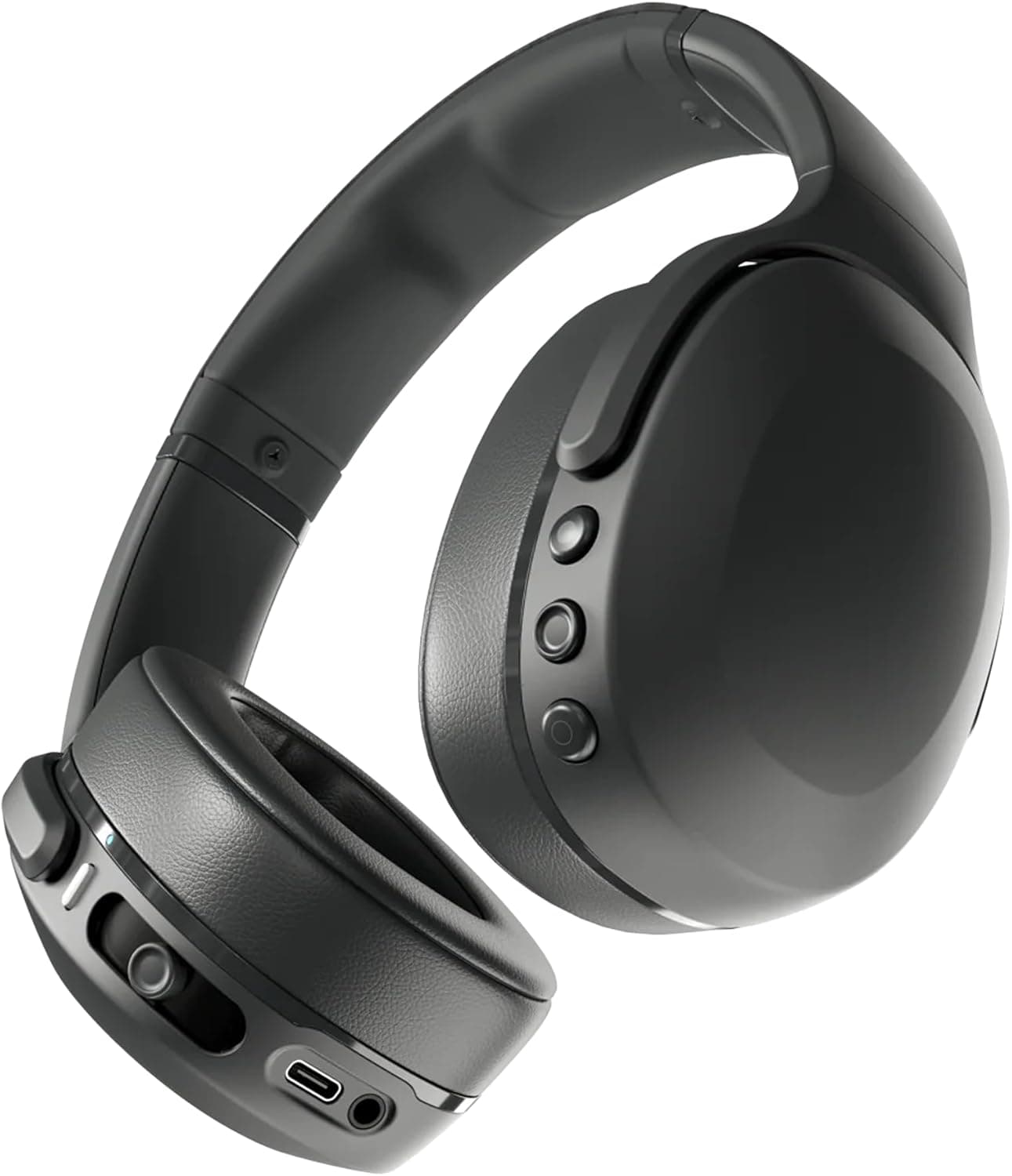
Skullcandy's spec sheet lists 40 hours of playback with a rapid-charge feature, Bluetooth wireless, flat-folding hinges for travel, and the Skull-iQ app carrying a Personal Sound hearing test that reshapes the EQ around your hearing. There's no active noise cancellation, and Skullcandy has never claimed there was; the closed-back cups rely on passive isolation alone. Materials are mostly plastic with a memory foam headband, which keeps the weight low and shows up as the main long-term durability grumble across the review pool.
Bottom line
Under $110 buys you genuinely impressive low-end response and battery life that outlasts pricier competitors. It doesn't buy noise cancellation, premium materials, or neutral sound reproduction, and Skullcandy has priced accordingly.
Bass-first listeners, commuters and gym-goers who want runtime and don't mind plastic will get on with these fine. Anyone shopping for ANC, wired studio monitoring or long-term ruggedness should look at other options in this price range or above.
How we assessed it
We're not an acoustic lab and this isn't a measurement review. What we did instead was cross-reference Skullcandy's published specs, meaning Bluetooth version, battery claims, the absence of any listed water-resistance rating, and the mechanical description of the bass slider, against the pattern running through roughly 19,000 aggregated public reviews on Amazon.ca, to see where real-world experience diverges from the marketing.
The Good & The Bad
thumb_up What We Loved
- check
The slider does something no EQ can
It's haptic motors, not software. Turning the dial changes how much the ear cups vibrate against your head, and it responds instantly, mid-track, without opening an app.
- check
Forty hours at $109.99
That runtime beats most headphones in the price bracket and plenty above it. Charging becomes a weekly thought rather than a nightly one.
- check
A real hearing test, included
Personal Sound builds an EQ curve around your ears specifically. It's a feature usually gated behind premium models, and here it costs nothing extra.
- check
Folds flat for a bag
The hinges collapse the whole headphone into the supplied pouch, which makes a genuine difference against rigid over-ears in a packed backpack or carry-on.
thumb_down Honest Drawbacks
- close
No active noise cancellation at all
Passive isolation is what you get. Flights, open-plan offices and buses will all leak through in a way they wouldn't on an ANC headphone, and at this price the Soundcore Q20i proves the omission isn't a budget necessity.
- close
The build is plastic where it counts
Housing and hinges are plastic rather than metal. It keeps the weight and price down. It also produces the single most common complaint in low-star reviews: hinge looseness and cushion wear inside the first year.
- close
Nothing here is neutral
Even with the slider at its lowest, the tuning sits well forward of flat. Classical listeners, anyone mixing audio, and podcast-heavy users will find the low end intrudes where they'd rather it didn't.
- close
Rapid-charge numbers are stated loosely
Skullcandy promises rapid charging without publishing a consistent minutes-to-hours ratio across its own marketing. Treat any figure you see as approximate rather than a spec you can plan around.
- close
Haptics eat battery
The 40-hour claim assumes restrained slider use. Owners who keep the bass dialled high report the runtime dropping noticeably, which is physics rather than a defect, but it does mean two people can get very different answers from the same headphone.
- close
Occasional connection drops
Bluetooth stutters turn up regularly enough in the review pool to mention. Not a majority complaint, and not severe when it happens, but frequent enough that it's a known quirk rather than bad luck.
Technical Breakdown
Battery life
Up to 40 hours + rapid charge
Haptic bass slider
Adjustable, physical dial
Active noise cancellation
Not included
Build materials
Mostly plastic housing, foam headband
Personal Sound hearing test
App-based, free
How It Works
Pairing takes a minute. The customisation, which is where these earn their price, lives in Skullcandy's app.
Charge and pair
Charge over USB-C, hold the power button until pairing mode starts, then connect from your phone or laptop's Bluetooth menu.
Install Skull-iQ
The app carries firmware updates, EQ presets and the Personal Sound test. Skip it and you're using maybe half of what you paid for.
Run the hearing test
Personal Sound plays tones across frequencies and volumes and builds an EQ profile from your answers. It takes a few minutes and it's worth doing properly, in a quiet room.
Set the bass slider
The dial on the ear cup raises or lowers haptic intensity live, independent of volume. Find your setting per genre rather than leaving it in one position.
Fold flat for transport
The hinges collapse the headphones into the included pouch, which is what makes them practical in a backpack or carry-on.
How It Compares
| Feature | Skullcandy Crusher Evo Wireless Bass Headphones | Typical Alternative |
|---|---|---|
| Price | $109.99 | $150-$300 for ANC over-ears |
| Battery life | Up to 40 hours claimed | 20-30 hours typical for ANC headphones |
| cancelActive noise cancellation | cancelNot included | Usually included at higher price tiers |
| Adjustable haptic bass | check_circleYes, physical slider | Rare; most competitors use app EQ only |
| Build materials | Mostly plastic | Often metal hinges/premium materials at higher price |
Frequently Asked Questions
Does the Skullcandy Crusher Evo have active noise cancelling?
No. The Crusher Evo blocks sound the old-fashioned way, with closed ear cups and a physical seal, and Skullcandy has never marketed it as an ANC headphone. On a plane you'll still hear the engines under your music. If cancelling noise is the priority, the Soundcore Q20i does real hybrid ANC for roughly half this price.
How long does the Skullcandy Crusher Evo battery last?
Forty hours is the claim, and owner reports broadly back it up at moderate volume with the bass slider set low. Crank the slider and it falls, because the haptic motors draw power the drivers don't. Rapid charge helps on a forgotten night, though Skullcandy states that ratio loosely enough that we'd treat it as approximate.
Is the bass slider adjustable in real time while music is playing?
Say you're at a rack of dumbbells and a track comes on that needs more thump. You reach up and push the dial, mid-song, and the ear cups start vibrating harder. It's a mechanical control on the cup, independent of volume, not a menu buried in an app. That immediacy is the whole reason people buy these.
Can you use the Crusher Evo wired with an aux cable?
Skullcandy's spec sheet doesn't list an aux cable as a headline inclusion for this model, so plan on Bluetooth as the intended connection unless the listing you're buying from says otherwise. Buyers who need a guaranteed wired fallback for a studio desk or an airline seatback should confirm that in writing first.
What does the Personal Sound hearing test on Skull-iQ do?
It's a hearing test inside the Skull-iQ app. The app plays tones at a range of frequencies and volumes, you confirm what you can hear, and it builds an EQ profile shaped around your actual hearing rather than a generic curve. Most headphones at $109.99 don't offer anything like it.
Are Skullcandy Crusher Evo headphones durable enough for daily commuting?
Roughly speaking, most owners get through a year without trouble, but a consistent minority describe loose hinges or flattened headband cushions somewhere between month six and month twelve. The build is plastic where rivals use metal, which is part of how the price stays under $110. Budget for that trade rather than being surprised by it.
library_booksReferences & Further Reading
Our reviews are informed by peer-reviewed research and authoritative health organizations. These sources provided context for this review:
- linkSkullcandy Official Product Specifications
- linkFCC Equipment Authorization Database (Bluetooth device compliance)
- linkAmazon.ca Product Listing and Customer Reviews
Editorial note: Links to external sources are provided for informational purposes. ReviewHubNow is not affiliated with these organizations and does not receive compensation for linking to them.
The Crusher Evo does the one thing it was designed to do, and does it well. Bass you can physically feel, adjustable on ...
Based on our research and analysis, Skullcandy Crusher Evo Wireless Bass Headphones scored 7.8/10. See the full verdict above for who it suits — and who should pass.
View Price on Amazon.caarrow_forwardVerify official availabilityWhat Owners Report
Recurring themes we found across public owner reviews.
Many owners specifically call out the bass slider as the reason they bought these and say it delivers a noticeably different, more physical listening experience than typical Bluetooth headphones.
A recurring theme in lower-star reviews is hinge or headband wear appearing after several months of regular daily use, along with occasional Bluetooth connection drops.
Multiple reviewers note the battery life claim holds up reasonably well in daily use, though it drops faster when the bass slider is turned up high.
Return eligibility depends on Amazon.ca's standard return policy for the seller at time of purchase; check the current listing for exact window and conditions.