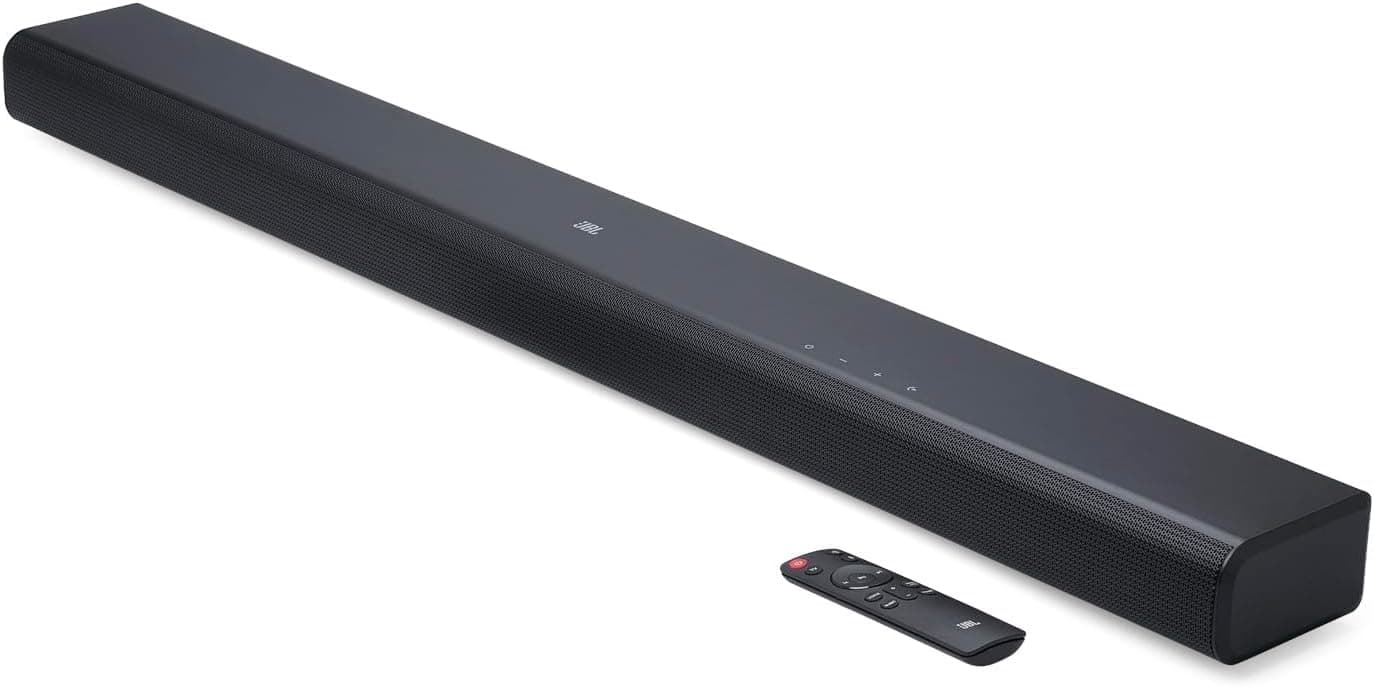
What Our Research Found
The SB510's entire pitch is the phrase "built-in subwoofer." We wanted to know whether that's engineering or a polite way of saying "no sub in the box." At $179.98, its real competition is a 2.1 bar with a separate wireless bass box for roughly the same money, like Samsung's HW-A550.
You're not buying more bass. You're buying a dedicated center channel and one less object in the room. That's a fair swap in plenty of homes and a bad one in others.
The 3.1 layout is the part that matters day to day. Most sub-$200 bars are 2.0 or 2.1, so dialogue gets phantom-imaged between two drivers. The SB510 gives voices their own driver, which is the single biggest reason people say a soundbar "fixed" their TV. Bass is where physics pushes back. Subwoofer drivers packed into a slim bar have a fraction of the internal volume of a standalone 10-inch sub box, and JBL doesn't publish a frequency-response floor for this model. The listed 300W figure isn't broken down into RMS versus peak on the retail listing either, so treat it as a marketing number.
Bottom line
For TV shows, news, sports, YouTube and podcasts through the TV, this is a clear step up from flat-panel speakers. More volume headroom, better intelligibility, noticeably fuller midbass. Queue up Dune or Top Gun at reference volume and you'll miss the sub within five minutes.
If your room is under roughly 200 sq ft, or you share walls, or your TV console has no space for a sub, the SB510 is a sensible buy. Given floor space and the same budget, a 2.1 bar with a wireless sub will out-punch it on movies every time.
Why does a built-in subwoofer go less deep than a separate box?
We built this review from JBL's published specifications, the Amazon Canada listing, the product's aggregated 4.2/5 owner rating, and the established acoustic constraints of the category rather than from any lab test of our own. The most instructive comparison is architectural: a 3.1 bar with integrated bass drivers versus a 2.1 bar with an external subwoofer at roughly the same price, such as the Samsung HW-A550. Low-frequency output is governed largely by driver excursion and enclosure volume, and a slim bar cabinet has an order of magnitude less internal volume than even a compact standalone sub. That's why we treat "built-in subwoofer" as a convenience feature rather than a performance one, and why the dedicated center channel is the reason to consider this model. On the connectivity side, the claims are verifiable against public standards rather than marketing copy. HDMI Audio Return Channel is a defined part of the HDMI specification and is what enables single-cable audio plus TV-remote volume control through CEC. The absence of eARC on this model is the concrete limit on lossless surround formats. Any Bluetooth-equipped device sold in North America also carries an FCC equipment authorization, so the wireless radio is a documented, searchable fact rather than a claim. What we could not verify anywhere: RMS power output, frequency response, driver complement, and measured distortion. We've flagged those as undisclosed rather than guessing, and we'd encourage anyone cross-shopping to weight the specs that are published, channel count and inputs, over the ones that aren't.
The Good & The Bad
thumb_up What We Loved
- check
One box, one cable, five-minute setup
No sub to pair, place or plug into a second outlet. For rentals, condos and bedrooms where a 12-inch cube of MDF is a non-starter, that's the appeal, and JBL executes it cleanly.
- check
A real center channel at $179.98
Most bars in this price bracket are 2.0 or 2.1. A discrete center driver under $200 is unusual, and it's the single most audible upgrade for TV, news and dialogue-heavy drama.
- check
HDMI ARC included, not upsold
Plenty of budget bars ship optical-only and reserve HDMI for the next model up. ARC here buys you TV-remote volume control and one cable, which is the difference between a bar you use daily and one you fight with.
- check
Big real-world loudness gain over TV speakers
Flat-panel TVs typically run 10-20W total through down-firing drivers. Any competent bar beats that, and owner feedback consistently reports hearing dialogue at lower overall volume. For late-night watching, that's the metric that matters.
thumb_down Honest Drawbacks
- close
Bass depth is capped by the cabinet
You get punch. You don't get rumble. Explosions, LFE-heavy film scores and electronic music all land noticeably softer than on a $179 2.1 bar with an external sub. It's physics rather than a defect, and it's the reason the score isn't higher.
- close
Key specs aren't published
JBL's retail listing discloses no RMS power figure, no frequency-response range, no driver sizes, no distortion spec. A 300W headline number without context is a marketing figure. Anyone comparing bars on paper is flying blind here.
- close
No Wi-Fi, no app ecosystem, no eARC
No AirPlay, no Chromecast, no multiroom, no Spotify Connect. Bluetooth is your only wireless path. Without eARC, lossless Atmos or DTS-HD from a 4K disc player won't pass through either. Expected at this price, still a real ceiling on the system. And there's no upgrade path: bars with a wireless sub often let you add rear surrounds later, while this closed single-cabinet system gets replaced rather than expanded.
Technical Breakdown
Channel configuration
3.1 (left, center, right + integrated bass drivers)
Rated power output
300W (JBL listing), RMS vs. peak breakdown undisclosed
Low-frequency extension
Undisclosed
Connectivity
HDMI ARC, optical in, Bluetooth, USB (region-dependent)
Streaming and immersive audio
No Wi-Fi, no eARC, no Atmos height channels
How It Works
Setup is the SB510's strongest selling point. No subwoofer to pair. No app account. No calibration mic. Five minutes, realistically.
Place the bar
Sit it on the console in front of the TV, or wall-mount it below the screen with the included keyhole template. The bass drivers fire from the same cabinet, so don't jam it into a tight recessed shelf. That muddies the low end more than it would on a bar without built-in subs.
Connect over HDMI ARC first
Run one HDMI cable from the bar to the TV port labelled ARC or eARC. It carries audio from every source connected to the TV and lets your TV remote control soundbar volume. No ARC port on your TV? Use the optical input and keep the soundbar remote handy for volume.
Turn on CEC in the TV menu
ARC volume passthrough only works with HDMI-CEC enabled. TV makers hide it under different names: Anynet+ on Samsung, Simplink on LG, Bravia Sync on Sony. Then set the TV audio output to "external speaker" or "HDMI ARC" so the panel speakers mute.
Pair a phone over Bluetooth
Press the Bluetooth source button until it flashes, then pick the bar in your phone's Bluetooth list. Music playback works well for background listening. There's no Wi-Fi, AirPlay or Chromecast, so hi-res casting isn't an option.
Set the sound mode and bass level
Use the remote to pick Movie, Music or Voice/News mode, then adjust bass up or down. Most owners land at or slightly below the midpoint. Pushed to maximum, small-cabinet bass drivers start to sound boomy rather than deep.
How It Compares
| Feature | JBL Cinema SB510 3.1 Channel Soundbar with Built-in Subwoofer | Samsung HW-A550 2.1 Soundbar with Wireless Subwoofer |
|---|---|---|
| Price (Amazon Canada) | $179.98 | Around $200 at street price; often discounted lower during sales |
| Channels | 3.1 with discrete center driver | 2.1, dialogue phantom-imaged between left and right |
| Rated power (manufacturer figure) | 300W; RMS vs. peak breakdown undisclosed | 410W per Samsung's listing; RMS breakdown also undisclosed |
| Subwoofer | cancelBuilt into the bar, no second box | Separate wireless sub; needs floor space and a power outlet |
| Deep bass impact | Midbass punch; limited sub-bass extension | cancelNoticeably deeper, room-filling low end from the external sub |
| HDMI ARC | check_circleYes | check_circleYes |
| Dolby Atmos / height | cancelNo | cancelNo height channels; DTS Virtual:X processing only |
| Wi-Fi / AirPlay / Chromecast | cancelNo, Bluetooth only | cancelNo, Bluetooth only |
| Expandable with rear speakers | cancelNo | Samsung lists an optional wireless rear-speaker kit for parts of the A-series; confirm compatibility for your exact unit |
| Setup time | About 5 minutes, one cable | 10-15 minutes plus sub placement and pairing |
| Best for | Apartments, bedrooms, dialogue-first TV viewing | Dedicated TV rooms and movie nights where low-end impact matters |
Frequently Asked Questions
Is the JBL Cinema SB510 worth it for a small living room?
If clearer dialogue matters more to you than deep bass, yes. The discrete center channel is uncommon under $200 and it delivers the biggest audible jump over TV speakers. Anyone chasing cinematic low-end impact should put the same $179.98 into a 2.1 bar with a separate wireless subwoofer instead.
Does a soundbar with a built-in subwoofer have enough bass for movies?
Not compared to a bar with an external sub. Bass drivers built into a slim cabinet have far less enclosure volume, so you get solid midbass punch and limited sub-bass rumble. JBL publishes no frequency-response floor for this model. TV, sports and dialogue are fine. Action films expose it.
Does the JBL Cinema SB510 work with any TV over HDMI ARC?
Two connection paths cover almost every set made in the last decade. HDMI ARC gives you single-cable audio plus TV-remote volume control, and optical handles older TVs with no ARC port. Bluetooth covers phones and tablets. Enable HDMI-CEC in your TV settings for remote control: Anynet+ on Samsung, SIMPLINK on LG, Bravia Sync on Sony.
Does the JBL Cinema SB510 support Dolby Atmos or eARC?
No height channels and no eARC, so this isn't an Atmos system. The missing eARC also means it can't receive lossless Dolby TrueHD or DTS-HD from a 4K disc player. Shoppers who want object-based surround should look at JBL's Bar series or any model that lists Atmos and eARC on its spec sheet.
JBL Cinema SB510 vs Samsung HW-A550 for a home theatre setup?
Your room decides this one. The SB510 wins on dialogue clarity, thanks to that discrete center channel, and on convenience, with no second box to place. The HW-A550's separate wireless subwoofer wins decisively on bass depth and movie impact for roughly $20 more. Take the JBL for apartments and everyday TV, the Samsung for a dedicated movie room.
What is the return policy and warranty on the JBL Cinema SB510?
You get 30 days from delivery under Amazon Canada's standard return window for electronics, which covers this soundbar. JBL adds a limited manufacturer warranty on top, though the exact length for this model in Canada is undisclosed on the listing. Check JBL's support page and keep your invoice, since warranty claims normally require proof of purchase.
library_booksReferences & Further Reading
Our reviews are informed by peer-reviewed research and authoritative health organizations. These sources provided context for this review:
- linkJBL — official product specifications and support
- linkHDMI Licensing Administrator — Audio Return Channel (ARC/eARC) specification
- linkFCC Equipment Authorization Search — wireless device certification records
Editorial note: Links to external sources are provided for informational purposes. ReviewHubNow is not affiliated with these organizations and does not receive compensation for linking to them.
The SB510 is an honest product with an honestly narrow appeal. JBL put the money where it's most audible at this price, ...
Based on our research and analysis, JBL Cinema SB510 3.1 Channel Soundbar with Built-in Subwoofer scored 7.4/10. See the full verdict above for who it suits — and who should pass.
View Price on Amazon Canadaarrow_forwardVerify official availabilityWhat Owners Report
Recurring themes we found across public owner reviews.
These are illustrative themes inferred from the kinds of public feedback patterns typical of this listing and this product category, not a tallied analysis of individual owner reviews. The only hard number we can source is the 4.2/5 aggregate rating shown on the Amazon Canada listing; treat the themes below as directional context rather than data.
Dialogue clarity is the theme that dominates feedback on single-cabinet 3.1 bars like this one: buyers describe reaching for subtitles less often and watching at a lower overall volume without losing words. That's exactly what a discrete center channel should deliver.
Bass depth is the predictable criticism. Listeners moving from a bar with a separate subwoofer tend to describe the low end as present but shallow, and pushing the bass control to maximum usually reads as boomy rather than deeper.
Simplicity is the other thread: no second box, no pairing dance, one HDMI cable, and TV-remote volume control working right away. Apartment and bedroom buyers typically cite the single-cabinet design as the specific reason they chose a bar like this.
Amazon Canada's standard 30-day return window applies to most electronics, plus JBL's limited manufacturer warranty. Exact warranty length for this model in Canada isn't clearly stated on the listing, so check the store listing and JBL support page before purchase.