What Our Research Found
Every Dyson conversation eventually arrives at the same question: what exactly costs a thousand dollars here? With the V15 Detect Plus, Dyson's answer has two parts. One is engineering. The other is theater. Both work.
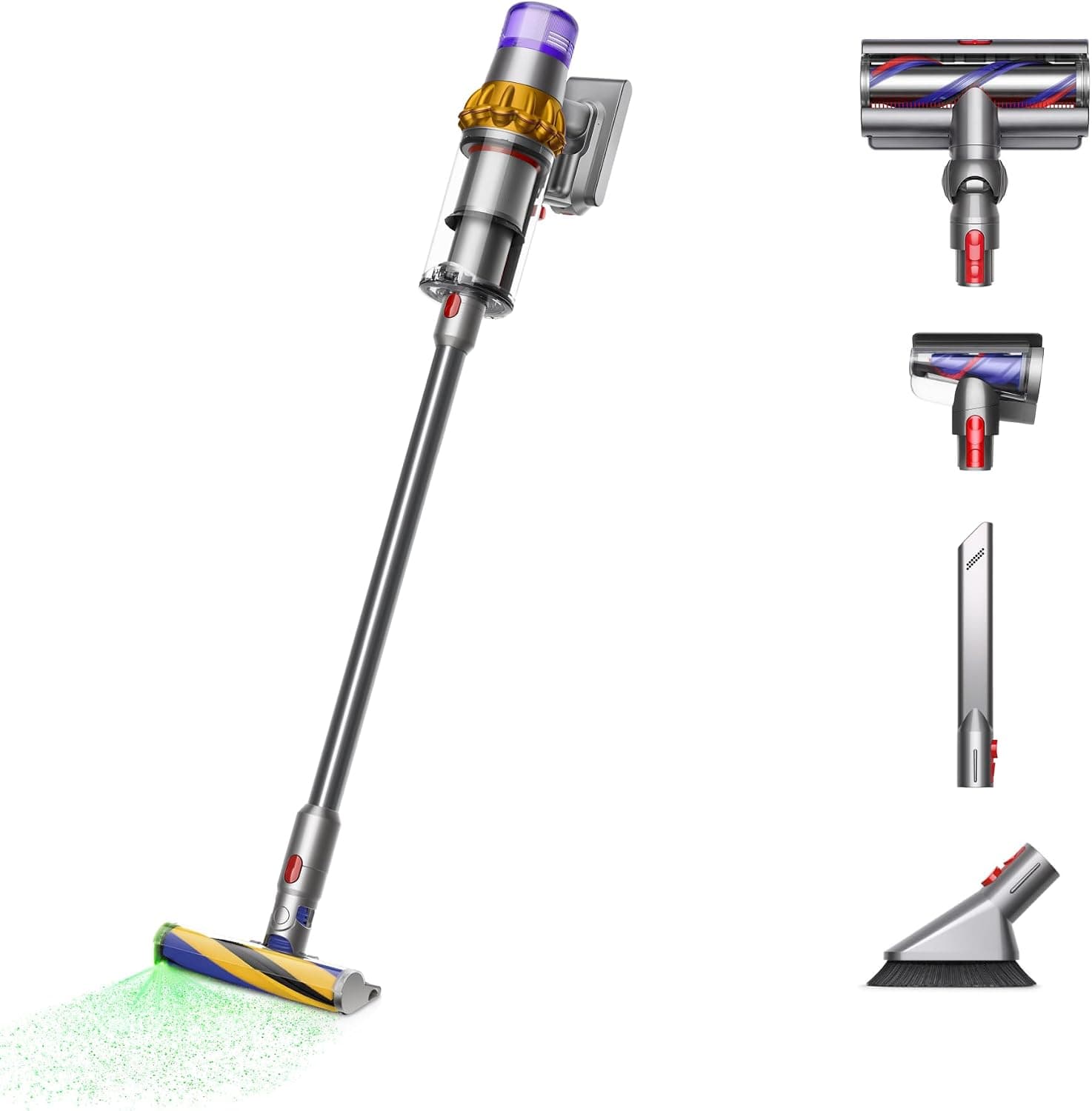
The theater is the famous green laser, and calling it theater isn't dismissal. It angles light across hard floors so dust you'd never see casts shadows, and owners consistently describe the same arc: horror at week one, mild obsession by week three. It changes cleaning behavior, which is a strange and real benefit.
The engineering half is the piezo sensor. It counts particles by size as they pass through the bin inlet and displays the tally on screen, while auto mode raises suction when the count spikes. On carpet, where the laser does nothing, the counter becomes the proof-of-clean instead. Battery runs up to about an hour in eco mode with the fluffy head; realistic mixed cleaning lands closer to half that, and boost mode drains in minutes. The bin empties with one satisfying lever throw. Owner sentiment sits at 4.4 stars across a large base, with battery-life expectations and the price forming most of the complaints.
Bottom line
What you get for the money over a mid-range stick: the sensor loop that adjusts power for you, the laser's behavioral magic, stronger deep-carpet pickup, and Dyson's filtration sealing. What you don't get: more runtime than cheaper rivals, or immunity from the physics of small bins.
In a detached home with a dog, this machine replaces an upright, a handheld, and most of your excuses. In a condo, it replaces $700 that could have stayed in your pocket.
Does the particle sensor actually mean anything?
The piezo sensor measures acoustic pulses from particles striking a surface at the bin inlet, sorting them into size buckets. It's a genuine engineering feature, not marketing: the counts drive the auto-suction loop and correlate with what the machine is actually ingesting. What it is not is an air-quality meter or a lab instrument. It counts what enters the vacuum, nothing more.
The Good & The Bad
thumb_up What We Loved
- check
The laser earns its hype
Owners describe cleaning floors they believed were clean and finding them filthy. Behavior change is the most underrated feature a vacuum can ship.
- check
Sensor-driven auto mode
Power follows dirt instead of a dial. Battery lasts longer and carpets get more when they need it, with zero thought from you.
- check
One machine for the whole house
Converts to handheld for stairs, cars, and furniture. The Plus kit's extra tools cover crevices, mattresses, and pet hair properly.
- check
Visible proof for allergy households
The particle counter turns 'I think it's clean' into a number going to zero. For asthma and allergy homes, that's worth real money.
thumb_down Honest Drawbacks
- close
The price is the product's biggest flaw
At $999.99, it costs more than three DREAME Z30s. Nothing about dust physics justifies that for a small space.
- close
Battery anxiety is real in big homes
Whole-house cleans in one charge require eco mode and discipline. Heavy carpet homes may need a mid-clean recharge, which stings at this tier.
- close
Small bin, frequent trips
Pet owners will empty it every session, sometimes mid-session. It's quick, but it's constant.
- close
The laser is a hard-floor party trick
Carpet-dominant homes lose the headline feature entirely and lean on the sensor alone.
- close
Filter maintenance is on a schedule
Wash the filter monthly or the sensing logic and suction both quietly degrade. Skipping it is behind most 'my Dyson lost power' stories.
Technical Breakdown
Laser dust detection
Hard floors only
Piezo particle sensor
Live count on LCD
Suction & filtration
Flagship-class, sealed
Battery reality
Up to ~60 min (eco)
Price
$999.99 at review time
How It Works
Setup is trivial. The learning curve is really about modes and expectations.
Charge and pick your head
The fluffy laser head is for hard floors only. The main torque head handles carpet and does the auto-suction adjustments.
Run auto mode by default
Let the particle sensor drive power. Eco is for battery stretching, boost for spot rescue jobs measured in seconds, not rooms.
Watch the counter, then stop trusting your eyes
The LCD shows particle counts falling as an area comes clean. It's the feature that quietly retrains how long you spend per room.
Empty after most sessions
Stick-vacuum bins are small by design. The point-and-shoot ejector makes it painless, but plan on doing it often.
How It Compares
| Feature | Dyson V15 Detect Plus | DREAME Z30 (value pick) |
|---|---|---|
| Current price | $999.99 | $299.99 |
| Dust detection | Laser + particle counter | cancelNone |
| Suction adjustment | Automatic, sensor-driven | Manual modes |
| Runtime claim | Up to ~60 min | Up to 90 min |
| Best fit | Large mixed-floor homes, allergies | Apartments, budget-first buyers |
Frequently Asked Questions
Is the Dyson V15 Detect Plus worth $1,000 in Canada?
If your home is large, carpeted, or full of pets, and you'll actually use the sensor-driven cleaning, the experience justifies the flagship price better than any rival. In a small apartment, realistically, no. A $300 stick covers the same floors and the leftover $700 buys a lot of other problems solved.
Does the Dyson laser actually work or is it a gimmick?
It works, with one big limit: hard floors only. The angled green light makes invisible dust cast shadows, and the effect on real cleaning habits is well documented in owner feedback. On carpet it does nothing. That's where the particle counter takes over as your proof of clean.
How long does the V15 battery really last?
About an hour in eco mode with the soft roller head, and closer to 30-40 minutes in realistic mixed cleaning on auto. Boost mode drains the pack in under ten minutes and exists for emergencies, not rooms. Large homes should expect to plan cleaning around the battery, not the other way around.
V15 Detect vs cheaper sticks like the DREAME Z30, what am I actually paying for?
Three things: the sensing loop (laser, particle counter, auto suction), stronger deep-carpet performance, and sealed flagship filtration. Raw hard-floor pickup on a mid-range stick is closer than the price gap suggests. If none of those three excite you, buy the cheaper machine without guilt.
Is the V15 good for allergies and asthma?
It's one of the strongest cases for buying it. Sealed filtration keeps captured particles in the machine, and the particle counter gives allergy households something rare: visible evidence that a mattress or sofa is actually clean, not just vacuumed.
What breaks first on Dyson stick vacuums?
Batteries age like all lithium packs, and Dyson sells replacements, which matters for keeping a $1,000 machine alive past year three or four. Owner-reported issues otherwise cluster on clogged filters from skipped maintenance. Wash the filter monthly and most horror stories don't happen.
library_booksReferences & Further Reading
Our reviews are informed by peer-reviewed research and authoritative health organizations. These sources provided context for this review:
- linkDyson Canada — V15 Detect official specifications
- linkAsthma Canada — Indoor air and allergen control
Editorial note: Links to external sources are provided for informational purposes. ReviewHubNow is not affiliated with these organizations and does not receive compensation for linking to them.
The V15 Detect Plus is what happens when a vacuum company runs out of suction to add and starts engineering feedback ins...
Based on our research and analysis, Dyson V15 Detect Plus Cordless Vacuum scored 8.3/10. It is one of our top recommendations in its category.
View Price on Amazon Canadaarrow_forwardVerify official availabilityWhat Owners Report
Recurring themes we found across public owner reviews.
The laser dominates owner reviews. People who swore their floors were clean describe genuine shock, and the particle counter gets credit for settling arguments about whether a room is done.
Battery expectations versus reality is the recurring sore point, especially in boost mode. Several long-term owners also mention the bin filling faster than they'd like with pets.
Upgraders from older Dysons and dying uprights report the least regret. First-time stick buyers sometimes wonder aloud if a cheaper machine would have made them just as happy.
Amazon Canada's standard 30-day return policy